What Are the Top Types of Eyeglass Showcases for Retail?

Choosing an Eyeglass Showcase is not only a matter of appearance. It shapes how customers browse frames, compare details, and ask for help. Retail anthropologist Paco Underhill has observed, “The longer a shopper stays in a store, the more he or she will buy.” That broad retail insight helps explain why clear sightlines and comfortable browsing matter in optical shops. It is not a guarantee of sales.

This guide introduces the main showcase types and the jobs they do. Countertop displays keep selected frames close to the consultation area. Wall-mounted units make use of vertical space and can create an orderly frame gallery. Freestanding showcases can define zones, while lockable glass cases offer added protection for higher-value collections. Modular systems allow retailers to adjust layouts as inventory changes. Small details matter.

Lighting deserves careful attention. Bright spots can create glare on glass, while dim corners hide frame colors and finishes. A practical layout gives customers room to look without crowding staff or blocking nearby displays. Not every store needs every type. A compact shop may benefit from a focused wall display and one secure case; a larger showroom may need several coordinated formats.

The right choice depends on floor space, frame range, security needs, and maintenance capacity. Glass fingerprints are easy to underestimate. This introduction leads into a closer comparison of showcase styles, materials, lighting, and placement, including trade-offs that product photos often conceal. A polished display can still be inconvenient if customers cannot comfortably see or reach the frames.
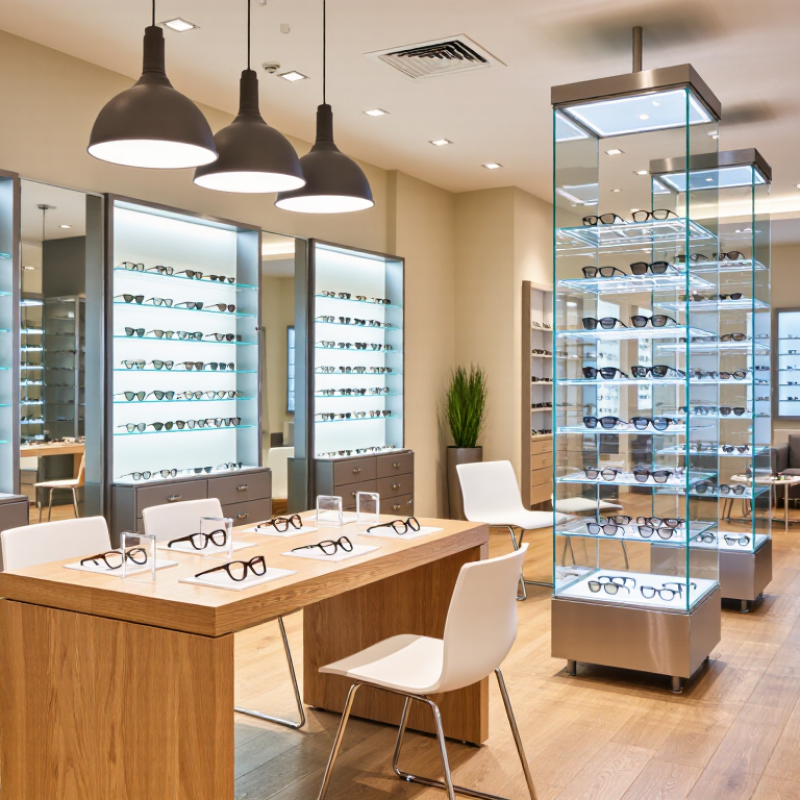
What Are the Top Types of Eyeglass Showcases for Retail?

Countertop Eyeglass Showcases for Compact Retail Displays

Countertop eyeglass showcases suit retailers with limited floor space and a need to keep frames within easy reach. Grand View Research valued the global eyewear market at $183.36 billion in 2023 and projected 8.3% annual growth through 2030. That scale makes product presentation worth careful attention, even on a small counter.

Choose a case with clear sightlines, sturdy hinges, and shelves that fit different frame shapes. A low-profile design lets customers see merchandise without blocking staff or nearby displays. Keep labels readable. Use focused lighting, but check for glare on lenses and glass before opening. A locked rear panel can help staff manage access while keeping the customer-facing side inviting. Small details matter.

Physical browsing still has a role: the U.S. Census Bureau reported that e-commerce represented 16.1% of U.S. retail sales in the fourth quarter of 2024, seasonally adjusted. A countertop display can support in-person comparison, though it cannot fix a cluttered counter. Leave room for a mirror and a clear place to set frames down. One trade-off is easy to overlook: a compact case may hold fewer styles, so rotate selections regularly and watch which frames customers actually pick up.


Wall-Mounted Showcases for Space-Efficient Product Presentation

Wall-mounted eyeglass showcases turn unused vertical space into a clear, easy-to-scan display. They work well in narrow shops, where floor fixtures can interrupt customer movement. Arrange frames by style, size, or color, and place popular shapes near natural eye level. Customers can compare silhouettes without leaning around a counter. That matters.

Choose shelves deep enough to support frames securely, but not so deep that products disappear from view. Sturdy brackets should suit the wall and the display’s full expected load; a qualified installer can check the mounting surface. Soft, even lighting helps reveal frame colors, while angled lights can create glare on glass. Keep a small mirror nearby so shoppers can try on frames without walking across the store.

A wall display can also make restocking and cleaning easier, especially when each frame has a consistent place. Leave enough space between pieces for hands to reach them comfortably. It is not perfect. A tightly packed wall may look efficient but feel less welcoming, and some customers prefer handling products before asking for help. Test the layout from the entrance and from a seated position, then adjust shelf heights where visibility or access feels awkward.

Freestanding Eyeglass Displays for High-Visibility Merchandising

Freestanding eyeglass displays put frames where shoppers can notice and handle them without asking for assistance. They work well near an entrance, along a clear aisle, or beside a fitting mirror. The best position depends on customer flow. A display that blocks a walkway can make browsing feel cramped.

Choose a sturdy base and shelves or arms that keep frames separated. This makes it easier to compare shapes and return each pair to its place. Keep popular styles near eye level, with heavier stock lower down. Small signs can identify frame materials or fit details, but too many labels create visual clutter. Good lighting matters. Aim for even illumination, since bright spotlights may cause reflections on lenses.

Capacity is not the only measure of a useful fixture. Shoppers need room to pause, and staff need access for cleaning and restocking. No display fits every shop. A tall unit may stand out in a spacious showroom but feel imposing in a narrow one. Measure the floor area before choosing, and check that the base stays steady when frames are handled. Leave enough space around it for browsing. That detail is easy to miss.

Lockable Glass Cabinets for Secure Eyewear Storage

Lockable glass cabinets are a practical choice for retailers displaying premium eyeglasses. Clear panels keep frames visible while limiting casual handling. A hinged cabinet suits a staffed counter; a sliding-door case can work better where aisle space is tight. Look for sturdy hinges, a reliable lock, and shelves that adjust for different frame sizes. Soft interior lighting helps customers compare details without opening the case.

Security matters, but a lock is only one layer. The National Retail Federation’s 2023 National Retail Security Survey estimated that U.S. retail shrink reached 1.6% of sales in fiscal 2022, or $112.1 billion. This figure covers retail broadly, not eyewear stores alone. It still shows why display design deserves attention.

Place cases where staff can see them, keep keys controlled, and check locks during routine opening and closing. A cabinet that is hard to access can frustrate shoppers, too. That trade-off is easy to overlook.

Tips: Keep popular styles near the service point, leave enough room to lift frames safely, and clean glass daily to reduce fingerprints. Test the lock with one hand before buying. Small detail. A useful one.

Modular Showcases for Flexible Retail Layouts

Modular eyeglass showcases let retailers change displays without rebuilding the whole sales floor. A shop can add, remove, or reposition sections as its assortment and customer flow change. Low drawers keep spare frames close at hand, while clear upper shelves make featured styles easy to browse. Small change, less disruption.

Before choosing a system, map the space and note where customers pause, turn, or queue. Check that display modules leave comfortable walking routes and do not block sightlines across the shop. Measure frame shelves with actual products; oversized gaps can make a collection look sparse, while tight spacing makes browsing awkward. Details matter.

For a compact store, narrow wall units can preserve floor space and keep frames visible. A wider island may invite hands-on browsing, but it needs room around every side. Use steady, even lighting to show frame colors accurately, and check for glare on glass panels. Modular units are useful, but their connections and finishes should still feel consistent. One compromise is that repeated sections can look plain. A layout may appear balanced on paper, then feel crowded once customers and staff are moving through it.

Top Eyeglass Showcase Types for Flexible Retail Layouts

Modular wall showcases lead for layout flexibility because sections and shelves can be rearranged or expanded. Freestanding islands also adapt well to changing floor plans, while countertop units and fixed glass cabinets are generally less configurable. Scores are qualitative planning ratings from 1 (lower flexibility) to 5 (higher flexibility), based on how readily each display can be rearranged or expanded; they are not market-share or sales data.

Members of