What Are the Top Environmentally Friendly Fans in 2026?

Choosing among Environmentally Friendly Fans in 2026 takes more than trusting a green label. The useful questions are practical: How much air does a fan move for each watt? Can its motor run quietly at low speed? Are replacement parts available? These details matter on warm afternoons, when a fan turns for hours above a desk or bed.

Energy-efficiency expert Amory Lovins is often associated with the principle, “The cheapest energy is the energy you don’t use.” It offers a useful lens for comparing fans: efficient operation can reduce electricity use, but the right size and placement matter too. A powerful fan in a small room may not be the best fit. Neither is a compact model that struggles to move air across a larger space.

This guide compares leading options through measurable performance, motor type, controls, materials, durability, and repairability. Where available, it considers independent efficiency ratings and manufacturer specifications, while distinguishing tested figures from marketing claims. Still, product data does not tell the whole story. A sleek finish may hide limited repair options, and “eco-friendly” does not automatically mean low-impact across a product’s life. No model is perfect. The aim is a clearer shortlist, not a promise of zero impact, so readers can weigh comfort, energy use, and long-term value for their own rooms.
What Are the Top Environmentally Friendly Fans in 2026?

Fan Types in 2026: Comparing Ceiling, Tower, Pedestal, and Table Fans

A fan’s environmental impact depends on more than its energy rating. How often it runs, how long it lasts, and whether it suits the room all matter. A well-sized fan on a low setting may use less electricity than a smaller model running at full speed.

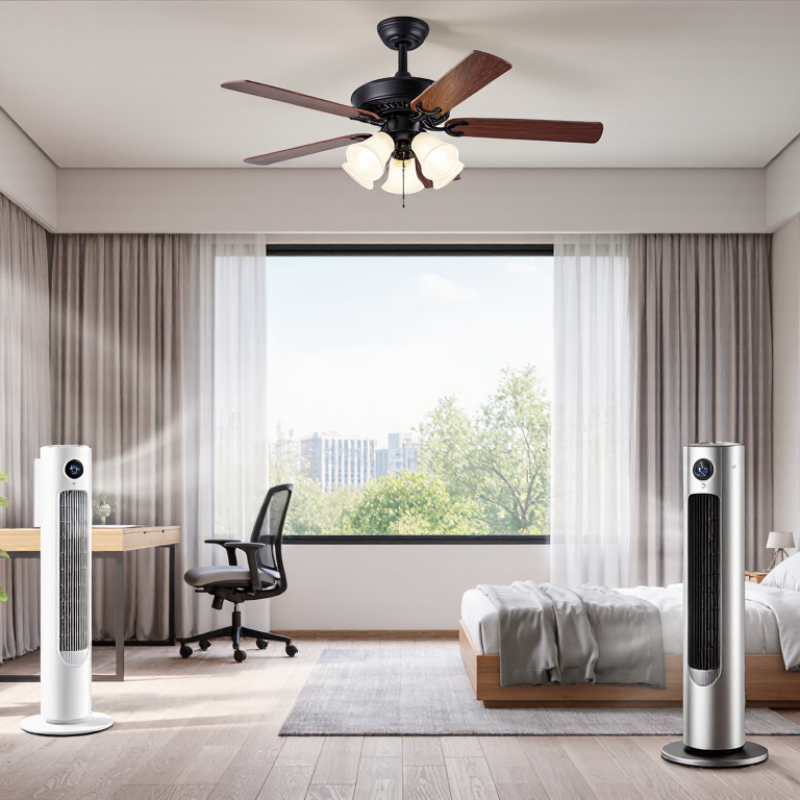
Ceiling fans move air across a broad area and can make occupied rooms feel cooler. In warm weather, this may let you raise the thermostat slightly, though results depend on insulation, humidity, and room layout. Installation takes planning, and a fan is less useful where people rarely gather. Placement matters.

Tower fans have a slim footprint and often include timers or several speed settings, useful in bedrooms and shared spaces. Their narrow airflow may not cool a whole room evenly. Pedestal fans can be aimed at a desk or seating area, while table fans suit close, personal cooling. Both are easy to move, but their benefit drops when they are pointed at an empty space.

Not a perfect fit.

When comparing options, check measured power use, sturdy construction, replaceable parts, and how easily dust can be cleaned from the grille. A durable fan that gets regular use may be the more practical choice, even if its upfront efficiency is not the highest.


ENERGY STAR Benchmark: Certified Fan-Light Kits Are 60% More Efficient

What Are the Top Environmentally Friendly Fans in 2026?

For efficient cooling and lighting, look closely at certified fan-light kits. ENERGY STAR reports that certified ceiling fan-light combinations are about 60% more energy-efficient than conventional models. That benchmark can mean lower electricity use during warm months, especially when a fan runs for several hours. Check the product’s airflow and energy-use ratings, not just its certification label. A quiet motor and dimmable lighting may also make everyday use more practical. Still, efficient hardware cannot compensate for a fan left running in an empty room.

Tips: Choose a fan sized for the room, switch it off when nobody is present, and use LEDs. The U.S. Department of Energy’s Energy Saver guidance says ceiling fans can help occupants raise thermostat settings by about 4°F while maintaining comfort.

Consider the whole setup, too. A fan moving air over a desk or bed can feel useful at a modest setting; a poorly placed unit may not. In my view, the 60% figure is a strong comparison, but real savings depend on runtime, room layout, and lighting habits. Compare certified models’ listed airflow and wattage before choosing. A little measuring helps.

Motor and Speed Design: ASHRAE Fan Laws Link Power to Speed Cubed

What Are the Top Environmentally Friendly Fans in 2026?

A fan’s efficiency depends on more than its motor label. Its speed control and fit with the duct or room matter, too. ASHRAE’s fan laws show that, under similar operating conditions, airflow changes in proportion to speed, while power changes approximately with speed cubed. Reduce speed by 10%, and ideal fan power falls about 27%. That is a meaningful gain from a small adjustment. ASHRAE’s Handbook—Fundamentals and the U.S. Department of Energy’s Improving Fan System Performance guide explain why system design matters alongside equipment selection.

Still, the cube rule is not a guarantee. Real systems have changing resistance, leakage, and motor-drive losses. A fan slowed too far may fail to move enough air, even if its meter draws less power. I’ve seen simple estimates miss this. Check actual airflow and electrical input at several speed settings; record the results, rather than trusting a dial or display alone. Variable-speed control can help match output to demand, especially when full airflow is needed only occasionally.

Tips: Start with clean grilles and an unobstructed path. Test one lower speed at a time, then confirm airflow where people actually need it. Small checks count. Keep a brief log of speed, comfort, and power use. If the room feels stuffy, the lowest setting may not be the best setting.

Materials and Lifespan: Assessing Recycled Content, Repairability, and Parts

A fan’s environmental value depends on what happens after its first summer. The Global E-waste Monitor 2024 reports that the world generated 62 million tonnes of electronic waste in 2022; only 22.3% was documented as formally collected and recycled. A fan is only one small part of that stream, but a dead motor or sealed control unit can turn a repairable appliance into waste. Look for a replaceable motor, accessible fasteners, and spare parts with clear availability dates.

Material claims deserve a closer look. The International Aluminium Institute says recycled aluminium uses about 5% of the energy required to produce primary aluminium. That is relevant when a fan uses aluminium in its frame or blades, but recycled content should be stated as a percentage, not a vague “eco” label. Recycled plastic can also help, though heat, UV exposure, and brittleness affect how well it holds up. Ask what components contain recycled material.

Repairability is practical, not abstract. Can you remove the grille with a screwdriver, clean the blades, and replace a capacitor without damaging the housing? Check whether the manual includes parts diagrams and whether common components have standard connections. That matters. A fan with a durable housing may still be a poor long-term choice if its electronics are sealed. I would not assume every “repairable” claim means affordable repairs; that part needs checking.

Environmentally Friendly Fans in 2026: Materials, Repairability & Lifespan

Global e-waste documented collection and recycling rates

What this means for choosing a fan: These global figures cover all electronic waste, not fans specifically. Prefer a fan with clearly stated recycled material content, screws and accessible components instead of permanent adhesives, and replaceable parts such as blades, controls, and the motor. Repairability can help keep a fan in service longer; clear material labeling can also make end-of-life sorting easier.

Sources: The Global E-waste Monitor 2020 (2019 data) and The Global E-waste Monitor 2024 (2022 data). Rates refer to e-waste formally documented as collected and recycled.

Room-by-Room Selection: Compare Airflow per Watt, Noise, and Energy Labels

In 2026, choose a fan by room, not by headline airflow alone. In a living room, compare airflow per watt: higher airflow for the same power usually means more efficient cooling. Check that figures were measured under comparable conditions. A large room may need a ceiling fan that moves air across the seating area, while a desk fan can serve one person with less energy. Look for the energy label used in your region, and read its test basis rather than relying on a top rating alone.

Quiet matters most in bedrooms and study spaces. Compare noise ratings at the speed you will actually use; a fan’s quiet setting may move too little air on a warm night. Listen for motor hum and clicking, too. Small details count. In kitchens, where heat and cooking smells collect, a washable grille and steady airflow may matter more than an especially low noise figure. Check energy use at several speed settings, plus standby consumption if the fan has electronic controls. I would not trust a quick hand test as proof of efficiency; it tells you how the breeze feels, not how much electricity produced it. That distinction is easy to miss.

Members of