Choosing a kitchen faucet can look simple until the details matter. A tall gooseneck may clear a stockpot, while a pull-down spray head can make rinsing leafy greens easier. But finish, cartridge quality, installation dimensions, and after-sales support also shape the daily experience. China has a large and varied faucet industry, making supplier comparisons useful—and sometimes difficult.
This guide introduces ten Chinese manufacturers of Kitchen Faucets and explains what buyers should examine before making a shortlist. Industrial designer Dieter Rams once said, “Good design is as little design as possible.” That principle offers a useful lens: a faucet should feel intuitive, work smoothly, and suit its setting without needless complexity. Still, elegant lines do not prove long-term reliability. A glossy finish can impress in a photograph, yet tell little about performance after years of use.
The comparison considers product range, manufacturing capabilities, material and finish options, quality documentation, export experience, warranty terms, and communication support. Where public evidence is limited, that uncertainty deserves attention rather than guesswork. A manufacturer’s catalogue is only part of the story; samples, technical documents, and clear answers matter too. Not every buyer needs the same supplier. A residential project may prioritize design flexibility, while a distributor may care more about consistent production and dependable lead times. There is no flawless ranking. Use this overview as a starting point, then verify the details that matter for your project.
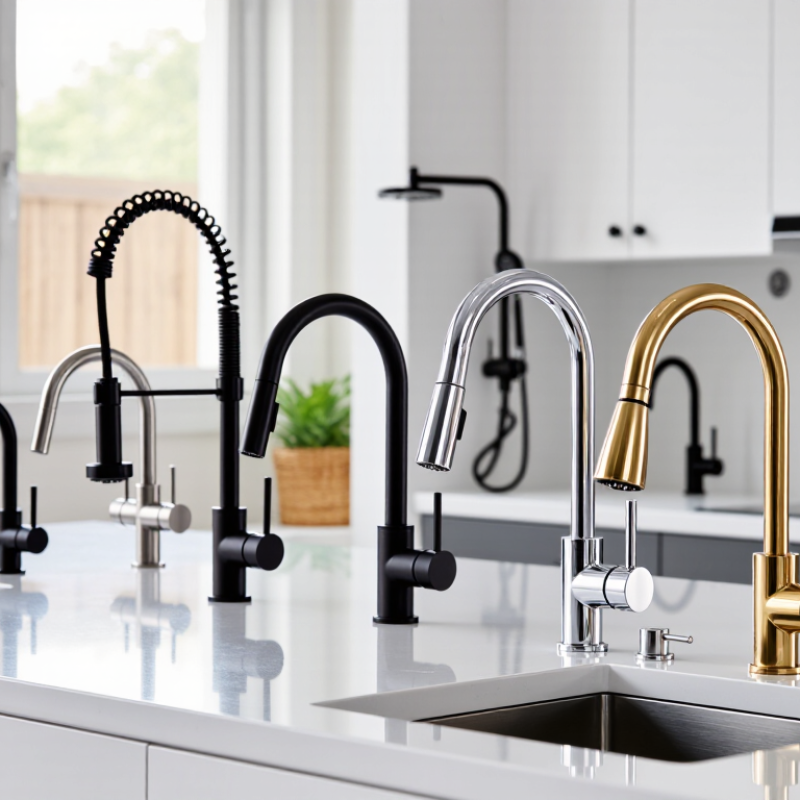
China’s kitchen faucet industry combines large-scale production with a broad network of specialized suppliers. Manufacturers may handle design, casting, machining, surface finishing, assembly, and testing in-house, while others rely on partner factories for selected steps. This creates flexibility, but production quality can vary between suppliers. The range is wide.
Common materials include brass and stainless steel, paired with ceramic cartridges, flexible hoses, and aerators. A faucet’s finish is more than appearance: coating preparation and inspection affect how well it resists scratches, water spots, and corrosion. Buyers should ask how samples are tested and whether inspection records are available. Details matter.
Many factories serve both domestic and export markets, adapting dimensions, packaging, and specifications to different customer needs. Production capacity alone does not show whether a supplier can maintain consistent tolerances or handle design changes. A factory visit can reveal useful details, such as how work-in-progress parts are stored and how defects are recorded. Yet a short visit is only a snapshot. I would compare samples, documentation, and communication over time before drawing firm conclusions. The industry is capable and fast-moving, but reliable sourcing still depends on careful verification.

The bars show the order of six common production stages, from forming faucet components to final inspection. This is a general process overview—not a ranking of manufacturers or a measure of market share; actual workflows vary by product and factory.
Choosing leading kitchen faucet manufacturers requires more than comparing prices or attractive product photos. Assess each company’s production experience, engineering capability, and quality-control process. Ask how it tests cartridge durability, water flow, leak resistance, and surface finishes. Clear test records are more useful than broad promises. Small details matter.
Review the materials used in faucet bodies and the consistency of parts across production batches. Confirm that product specifications and relevant compliance documents are available for the intended market. Check whether the manufacturer can provide installation guidance, spare parts, and responsive after-sales support. These details affect long-term use, not just the first impression. Factory audits or independent inspections can offer further evidence, especially for large orders. No scorecard is perfect; public information may be incomplete, and suppliers can change over time. Record what you verify, note what remains uncertain, and compare manufacturers against the same practical criteria.
Use these 10 criteria to evaluate and compare manufacturers. The weights below are a suggested assessment framework, not a published market ranking or verified ratings of individual companies. Check certificates, test reports, and factory records for the specific products and target market.
| No. | Evaluation criterion | Suggested weight | Evidence to request | Why it matters |
|---|---|---|---|---|
| 1 | Product safety and market compliance | 15% | Current certificates or test reports applicable to the destination market and exact faucet model. Examples may include NSF/ANSI/CAN 61 and NSF/ANSI 372 for relevant drinking-water-contact requirements, or ASME A112.18.1/CSA B125.1 for applicable plumbing fittings. | Requirements differ by market and product. Documentation should match the model being purchased, not just a similar product or the factory in general. |
| 2 | Materials and component traceability | 12% | Material specifications for water-contact parts, cartridge and hose information, supplier records, and incoming-material inspection procedures. | Material choice and component consistency can affect product performance, compliance, and long-term reliability. |
| 3 | Quality management system | 12% | Quality-system certificates with their scope and validity checked, documented inspection procedures, corrective-action records, and lot or batch traceability. | A documented system helps show how production issues are identified, recorded, and addressed. |
| 4 | Product testing and reliability | 12% | Test methods and results for relevant properties such as leakage, pressure resistance, operating cycles, coating performance, and cartridge function. | Test evidence helps buyers assess whether products have been evaluated against defined requirements. Confirm the test scope and tested model. |
| 5 | Manufacturing capability and process control | 10% | Factory audit records, process flow, production equipment information, in-process inspection points, and capacity information supported by production records. | Process control and realistic capacity can affect consistency, lead times, and the ability to fulfill repeat orders. |
| 6 | Engineering and customization capability | 10% | Engineering resources, drawings and specifications, prototype and sample procedures, change-control records, and documented tooling arrangements. | Clear engineering processes support custom requirements while helping control design changes and product specifications. |
| 7 | Water efficiency and product performance | 8% | Flow-rate data measured under stated conditions and, where relevant, evidence of eligibility for programs such as EPA WaterSense in the United States. | Flow performance should be checked against local requirements and the intended application; program eligibility is product-specific. |
| 8 | Supply-chain and delivery management | 7% | Documented lead times, order-planning procedures, component sourcing controls, packaging specifications, and records of on-time delivery performance. | Reliable planning and sourcing can reduce supply interruptions and help buyers coordinate production and shipping schedules. |
| 9 | Warranty and after-sales support | 7% | Written warranty terms, spare-parts availability, defect-claim procedures, response channels, and service responsibilities for the destination market. | Defined support arrangements make it easier to resolve product issues and obtain replacement parts after delivery. |
| 10 | Export documentation and communication | 7% | Sample commercial and shipping documents, packaging and labeling capabilities, export-market references that can be checked, and documented communication procedures. | Accurate documentation and clear communication help manage compliance checks, shipment coordination, and product requirements. |
| Total suggested weight | 100% | Score each manufacturer against the same evidence requirements and verify documents with the issuing bodies or testing organizations where possible. | ||
These ten profiles describe common manufacturing strengths, not a verified sales ranking. One manufacturer may focus on brass bodies, with machining and polishing handled in-house. Another may specialize in stainless-steel faucets for homes and busy kitchens. A third may offer OEM production, adapting dimensions and finishes to buyer specifications. Details matter.
These distinctions are practical, but they are not guarantees. Factory capability can vary between product lines, and a polished sample does not prove consistent batch quality. Request material specifications, inspection records, and production samples. Check how the faucet mounts, connects, and performs under repeated use. A few suppliers may answer slowly. That matters too. Compare the exact model, not just the catalog photos.
Chinese kitchen faucet manufacturers differ less by catalogue size than by process control. Typical capabilities include brass-body casting, CNC machining, ceramic-cartridge assembly, surface finishing, and leak testing. Ask whether tests cover pressure cycling, corrosion resistance, and flow consistency—not just a single final inspection. UNIDO’s Industrial Development Report 2024 places China at roughly 31% of global manufacturing value added in 2022. That scale supports broad supplier networks, but it does not prove any individual faucet is reliable.
Key product features include pull-down spray heads, swivel spouts, touch controls, and water-saving aerators. Manufacturing quality depends on details: cartridge tolerances, hose connections, coating thickness, and repeatable assembly. Request material specifications and test records for the exact model. A polished sample can conceal uneven production. This is easy to overlook.
Tips: Compare production samples with pre-shipment inspection results. Confirm spare-part availability, packaging protection, and stated flow rates. Ask how defects are tracked between batches. If answers are vague, pause.
Comparing Chinese kitchen faucet manufacturers takes more than checking prices and product photos. Ask whether the factory makes cartridges, bodies, and finishes in-house, or buys them from suppliers. Request a process flow, recent inspection records, and a sample matching the quoted model. Ask for evidence. A polished sample alone proves little.
Technical claims should match the destination market. The U.S. Department of Energy sets a 2.2-gallon-per-minute maximum flow rate for kitchen faucets at 60 psi. Compare test conditions, not just catalog figures. For drinking-water contact, check whether the exact model is covered by NSF/ANSI/CAN 61; NSF/ANSI/CAN 372 sets a 0.25% weighted-average lead-content limit for wetted surfaces. Verify certificates with the issuing body, including model numbers and manufacturing sites.
A factory audit can reveal details a video call misses: uneven plating near the spout joint, loose handles, or poorly labeled cartons. Request leak, salt-spray, and cycle-test results, and clarify how defects are handled after shipment. I would not treat a low minimum order as proof of flexibility; it may simply reflect a limited production run. Compare landed cost, spare-part availability, sample lead time, and written warranty terms before choosing. A small detail can become an expensive one.
Please share your email with us to see your results.