How to Choose the Best Square Light for Your Needs?
Choosing the right Square Light is about more than matching a room’s geometry. The fixture must provide comfortable, useful illumination where people read, cook, work, or relax. A neat square panel can still create glare or leave a desk dim. Looks matter. So do its measurable specifications.
The U.S. Department of Energy reports that LED lighting uses at least 75% less energy and can last up to 25 times longer than incandescent lighting. These figures describe LED technology broadly, not every Square Light; actual performance depends on the product and how it is used. Check lumens for brightness, color temperature for the character of the light, and color rendering for how accurately surfaces appear. Also consider room size, ceiling height, dimmer compatibility, installation method, and whether the fixture will be exposed to moisture. Small details count.
Human comfort deserves equal attention. Lighting researcher Mariana Figueiro has described light as “the most powerful synchronizer of the human circadian system.” Her work is a useful reminder that brightness and timing can shape how a space feels, though one fixture cannot guarantee better sleep or wellbeing. Start with the room’s purpose, then compare verified product data, warranty terms, and installation requirements. If specifications are unclear, pause before buying. I once underestimated how harsh a cool-white ceiling panel could feel at night; the lesson was simple, but easy to overlook. A thoughtful choice balances efficiency, comfort, appearance, and the actual needs of the people using the room.
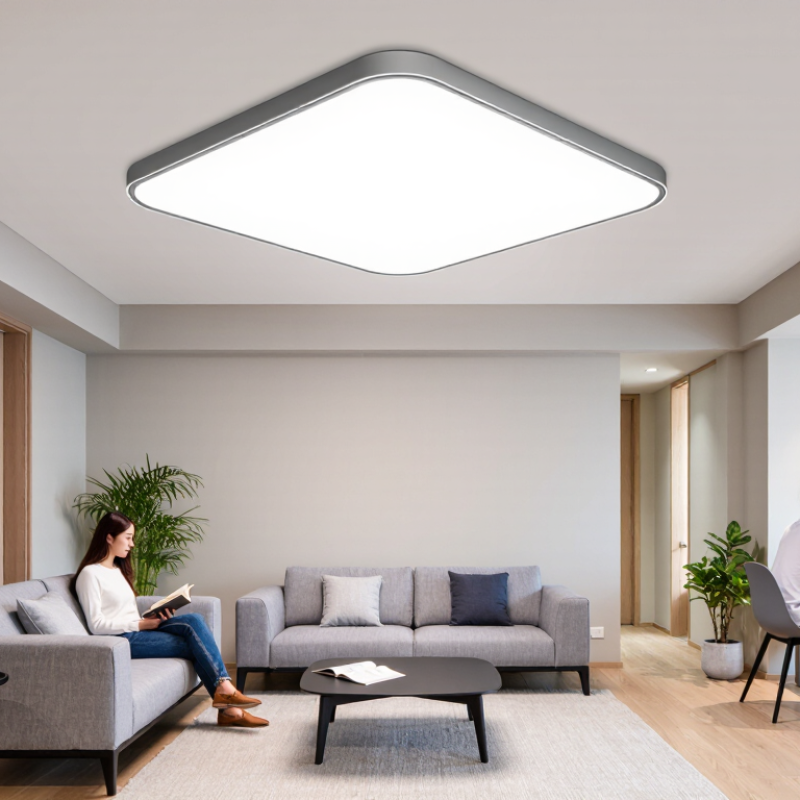
Identify the Task: Use IES Guidance of 300–500 lx for Many Office Areas
When choosing a square light, start with the work people do beneath it. IES guidance commonly gives 300–500 lx as a useful range for many office areas, measured on the work surface. It is a starting point, not a universal target. Fine drawing, reading small print, or work by older occupants may call for different lighting. Check the task and the applicable guidance before choosing a fixture.
Think about the desk, not just the ceiling. A square panel can spread light evenly, but its size, height, and placement affect the illuminance that reaches the workplane. Check the workplane. A lux meter can help confirm levels after installation; daylight and pale or dark surfaces can change the result. Also look for glare on monitors and shadows around keyboards. I would not choose by wattage alone. Review the fixture’s light output and distribution, then adjust its position or use task lighting if readings fall outside the intended range.
One detail is easy to overlook: a room can measure well on average while a corner desk still feels dim.
Compare Light Output and Efficiency in Lumens and Lumens per Watt
When comparing square lights, start with lumens, not the wattage printed on the box. Lumens indicate how much visible light a fixture produces. A small laundry room may need less light than a kitchen counter where you chop vegetables. Measure the space, note its purpose, and check the fixture’s stated lumen output. Numbers help.
Then compare lumens per watt, often written as lm/W. This figure shows how efficiently a light converts electricity into visible light: higher efficacy generally means more light for the same power. For example, a 2,000-lumen fixture using 20 watts delivers 100 lm/W. A 2,000-lumen model using 30 watts delivers about 67 lm/W. The first uses less power for similar stated output, but efficiency alone does not tell the whole story.
Look for the fixture’s delivered lumens, not only the LED module’s output. Diffusers, reflectors, and the square housing can reduce or redirect light. A bright number may still produce uneven corners or glare on a glossy table. I’ve found it useful to compare specifications under the same measurement conditions, though product listings do not always make those conditions clear. Check the beam distribution and color temperature, too. A sample installed in the actual room can reveal details a specification sheet misses. That extra check takes time, but it may prevent a harsh, overly bright ceiling.
How to Choose the Best Square Light for Your Needs? — Compare Light Output and Efficiency in Lumens and Lumens per Watt
Representative specifications for common square LED light types. Compare lumen output and fixture efficacy alongside size, color quality, and intended use. | Square Light Type | Approx. Size | Light Output | Power | Efficacy | Typical Color Quality | Suitable Applications |
| Compact recessed square downlight | 150 × 150 mm (about 6 × 6 in) | 900 lm | 10 W | 90 lm/W | 3000 K or 4000 K; CRI 80+ | Small rooms, hallways, and focused residential lighting |
| Small square LED panel | 300 × 300 mm (about 12 × 12 in) | 1,800 lm | 18 W | 100 lm/W | 4000 K; CRI 80+ | Small offices, utility rooms, and evenly lit work areas |
| Medium square recessed ceiling light | 300 × 300 mm (about 12 × 12 in) | 2,000 lm | 20 W | 100 lm/W | 3000 K or 4000 K; CRI 80+ | Kitchens, meeting rooms, and general indoor lighting |
| Square LED troffer or panel | 600 × 600 mm (about 24 × 24 in) | 3,600 lm | 36 W | 100 lm/W | 4000 K; CRI 80+ | Offices, classrooms, and suspended ceiling grids |
| Outdoor square LED floodlight | About 200 × 200 mm (about 8 × 8 in) | 3,000 lm | 30 W | 100 lm/W | 4000 K; CRI 70+ | Building entrances, pathways, and outdoor security lighting |
How to compare: Lumens (lm) indicate total light output; lumens per watt (lm/W) indicate how much light a fixture produces for its electrical power. Efficacy is calculated as lumens ÷ watts. These figures are representative examples, not product guarantees; actual performance varies by design, optics, driver, and operating conditions. Choose the lumen level for the space, then check glare control, dimming, color temperature, CRI, and any required damp- or wet-location rating.
Select Color Quality: CRI Is Rated on a 0–100 Scale
A square light can make a room feel crisp, but its color quality affects what you actually see. CRI, or Color Rendering Index, is rated from 0 to 100; higher scores generally indicate more faithful color appearance. The U.S. Department of Energy’s guidance on LED color characteristics describes this scale and its role in comparing light sources. A CRI of 80 or above suits many everyday spaces, while 90 or higher can help in kitchens, studios, and dressing areas. Check paint swatches under the fixture, not just on a screen.
The CIE’s technical method, CIE 13.3-1995, calculates general CRI using eight test color samples. That gives a useful comparison, but it does not capture every color nuance, especially saturated reds. CRI also does not tell you whether light is warm or cool; check the listed color temperature separately. A high score is helpful, not magic. I’d compare the actual light on familiar objects before choosing.
Tips: Hold a red apple, a white shirt, and a skin-tone sample beneath the square light. If reds look dull or whites seem oddly tinted, compare another fixture with a higher CRI. Also review the product’s published test data; “high CRI” alone is vague. The room’s wall colors can shift what you notice, too.
Match Color Temperature: Compare Warm 2700 K with Cool 5000 K
A square light’s color temperature changes how a room feels, even when its shape and brightness stay the same. At 2700 K, the light appears warm and slightly amber. It often suits bedrooms, living rooms, and dining areas, where a softer atmosphere feels comfortable. Picture a square ceiling fixture above a wooden table: warm light can bring out the grain and make evening meals feel relaxed. But it may make white walls look creamier than expected. That can be pleasant—or not.
At 5000 K, light looks cooler and closer to daylight. It can help details stand out in a laundry room, work area, or garage, especially when you are sorting small items or reading labels. Still, cooler does not automatically mean brighter; brightness depends on the fixture’s output, measured in lumens. Check the light in the actual room if possible. A paint sample, pale countertop, or glossy tile can look different under each temperature. Compare both settings in daytime and after dark. I would not trust a number alone: wall color, shades, and dimmers all affect the result. That extra check takes time, but it can prevent a square light from feeling oddly harsh once installed.
Check Placement and Protection: Use IEC 60529 IP Ratings for Damp Areas
A square light can suit a bathroom, laundry room, or covered porch, but its shape says nothing about its moisture resistance. Check the IEC 60529 IP rating before choosing a location. The first digit describes protection against solid particles; the second describes protection against water. An IP44 fixture, for example, resists splashing water, while IP65 offers protection against water jets. Neither rating means a light can be submerged.
Match the rating to the actual exposure. A ceiling outside a shower may face occasional steam and droplets, while a fitting directly above a shower can receive frequent spray. A covered porch may stay dry in ordinary weather but get wet when wind blows rain sideways. Small details matter. Check the fixture instructions for approved locations, and confirm that its rating applies to the complete installed unit, including any seals or covers.
A rating is useful, but it is not magic. Dust, aging seals, and poor installation can weaken protection over time. I would not assume that a higher number solves every placement problem; heat, ventilation, and cleaning methods matter too. Recheck seals if the light is near regular splashing, and ask a qualified electrician when wiring or location requirements are unclear. One overlooked gap can matter.