Choosing a greenhouse cover is a crop decision, not just a purchase. Greenhouse Covering Film affects incoming light, heat retention, condensation, and how often a structure needs re-covering. Small differences matter. A cloudy morning, droplets on the inner surface, or a hot afternoon can expose weaknesses that a product brochure may not show.
The USDA National Agricultural Statistics Service reported $13.8 billion in U.S. floriculture, nursery, and greenhouse crop sales in its 2019 Census of Horticultural Specialties. That scale makes reliable crop protection an operational concern. FAO’s 2021 report, The State of the World’s Land and Water Resources for Food and Agriculture, estimates that agriculture accounts for about 70% of global freshwater withdrawals. Film does not solve water scarcity, but its light and temperature effects can influence greenhouse conditions and management.
This guide compares films by measurable properties, including light transmission, haze, UV stability, thermal performance, anti-drip treatment, thickness, and expected service life. ASTM D1003 provides a method for measuring haze and luminous transmittance in transparent plastics; EN 13206 covers thermoplastic films used in agriculture and horticulture. These references help buyers ask better questions. They do not guarantee results in every climate or crop. That part is easy to overlook. A technically impressive film may still be a poor fit if local wind, temperature swings, installation quality, or replacement costs are ignored. The best choice is the one whose documented performance matches the growing site—and whose claims can be checked.
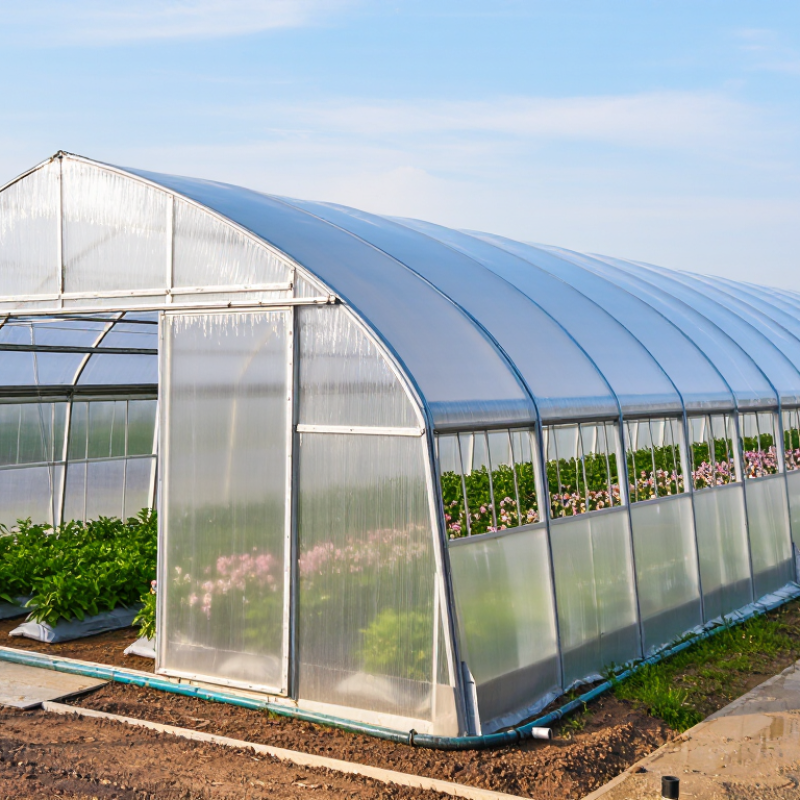
Before selecting greenhouse covering film, define the job it must do. List your crops, planting dates, and target harvest periods. Tomatoes generally need strong light and warmth, while lettuce can suffer when temperatures rise. Then assess local conditions: summer heat, winter lows, wind, rain, and available water. NOAA’s 1991–2020 U.S. Climate Normals can help reveal seasonal temperature and precipitation patterns; check your nearest station, not just regional averages. A film suited to a mild coastal site may overheat crops in a sunny inland valley.
Tips: Sketch the greenhouse at midday and note where shadows fall. Record daily temperatures and humidity for several weeks. FAO AQUASTAT estimates that agriculture accounts for about 70% of global freshwater withdrawals, so include irrigation capacity in your planning. This global figure is not a greenhouse-specific benchmark, but it underscores why water availability matters. Compare the crop’s light needs with film light transmission and diffusion, and consider whether extra heat retention would help or cause stress. Small differences in shade can matter.
Be specific about trade-offs. A grower might want warmer nights but still need to limit scorching afternoon temperatures. I would not choose a film from crop name alone; the same crop behaves differently under different seasons, ventilation, and irrigation. Write down the conditions you can control and the ones you cannot. That list makes later film comparisons more useful—and may expose a few assumptions worth checking.

Choosing a greenhouse film means balancing durability against usable light. Standard polyethylene is inexpensive and easy to replace; a 6-mil film is a common practical choice.
Penn State Extension’s greenhouse-covering comparison gives typical light transmission near 85–90% for single-layer polyethylene, about 80% for double-layer polyethylene, and roughly 90% for glass. Actual readings vary with film age, dust, condensation, and measuring conditions.
Small differences matter.
Thickness alone does not tell the whole story. UV-stabilized polyethylene can last longer outdoors, while anti-drip or diffuse-light treatments may help manage droplets and soften harsh sun.
Compare the product’s stated transmission with a meter reading inside your structure, especially near crop height. Check the crop. For light-demanding seedlings, a clean, clear film may be preferable; in hot climates, some diffusion or shading can reduce leaf scorch, though it can also lower total light.
Penn State Extension notes typical values, not guarantees for every film. I would not choose by the brightest specification alone: temperature, ventilation, and film maintenance can change real growing conditions. A neglected high-transmission cover may perform worse than a simpler film kept clean.
How to Choose the Best Greenhouse Covering Film in 2026?
Assess Climate Control, UV Protection, and Durability
Climate control depends on your local weather and what you grow. In cold regions, a film with good heat retention can reduce overnight temperature swings. In hot, bright areas, diffused light may soften harsh sun and help limit scorching. No film replaces ventilation. On a still afternoon, open vents and a working thermometer can matter more than a small difference in film specifications. Small details matter.
Check the product information for UV stability and expected service life. UV exposure, wind, installation tension, and cleaning practices all affect how long a covering lasts. A brittle edge or loose fixing can become a tear after one storm. Thicker film may resist damage better, but thickness alone does not guarantee durability. I would compare stated performance and replacement needs, while remembering that estimates are not promises.
Tips: Match light transmission and heat retention to your crops and climate. Inspect seams and fasteners before installation. Keep a simple temperature log through sunny and cloudy days; your greenhouse may behave differently than expected. That is worth noticing. If condensation is a concern, check whether the film is designed to reduce droplets, and monitor humidity rather than assuming the covering solves it.
| Film type | Typical light transmission | Climate-control performance | UV protection and behavior | Typical service life | Best suited to | Key trade-off |
|---|---|---|---|---|---|---|
| Clear UV-stabilized polyethylene (PE) | About 85–90% for many clear films; actual transmission depends on thickness, additives, and condition. | Provides good daylight and basic weather protection. A single layer offers limited insulation; a properly inflated double layer reduces heat loss. | UV stabilizers help slow sunlight-related film degradation. They do not necessarily block all UV from entering the greenhouse. | Commonly around 2–4 years for greenhouse-grade films, depending on formulation, climate, installation, and care. | General-purpose production where affordability and high light transmission are priorities. | Basic clear film may produce harsh direct light and can lose heat quickly if installed as a single layer. |
| Thermal / IR-retention PE | Often comparable to clear PE, but the exact figure varies with the infrared-retaining additives used. | Designed to reduce some long-wave infrared heat loss at night; useful in cool seasons and climates with large day-to-night temperature swings. | UV stabilization is a separate formulation feature. Check the product specification for both UV durability and the desired UV-transmission behavior. | Often about 2–4 years; the IR function and film life depend on the specific product and exposure conditions. | Cool regions, winter production, or growers seeking better overnight heat retention. | Does not replace heating, ventilation, or a second inflated layer; performance varies by film formulation. |
| Diffused-light PE | Often approximately 80–88%, with a portion of incoming light scattered rather than transmitted in a direct beam. | Spreads light more evenly through the crop canopy, which can reduce strong sun patches and improve light distribution; it is not, by itself, an insulation upgrade. | UV resistance depends on the stabilizer package. Diffusion describes how light is scattered, not whether UV is blocked. | Typically around 2–4 years for greenhouse-grade versions, subject to the same exposure and maintenance factors as other PE films. | Bright locations and taller or dense crops where more even light distribution is useful. | Transmission may be lower than a comparable clear film, and diffusion alone does not control greenhouse temperature. |
| EVA (ethylene-vinyl acetate) greenhouse film | Often roughly 88–92% for clear grades; grade, thickness, and additives affect the actual value. | Some grades offer useful flexibility and thermal performance; IR behavior depends on the formulation rather than the material name alone. | UV stabilizers and UV-transmitting or UV-blocking properties are product-specific; verify the film’s technical data sheet. | Often around 2–4 years for greenhouse films, although premium formulations and local conditions can change service life. | Growers seeking a flexible film with high light transmission and a formulation tailored to local conditions. | Properties and price vary considerably between grades, so compare measured specifications rather than relying on the material label. |
How to compare: Figures above are indicative ranges for common greenhouse films, not guaranteed specifications. Ask suppliers for tested light transmission, light diffusion, UV-transmission or UV-blocking data, IR/thermal performance, thickness, warranty, and expected service life for the exact film. Film life also depends on local UV intensity, wind, temperature, installation tension, chemical exposure, and maintenance.
A low purchase price can hide a higher cost over time. Compare the full installed cost, not just the price per square metre. Include film, fasteners, labour, access equipment, and removal of the old covering. Measure the frame carefully. A small sizing error can create extra seams or waste. Measure twice.
Estimate service life using the supplier’s stated range, then adjust for local conditions. Strong sun, wind, temperature swings, and contact with chemicals can shorten a film’s useful life. Installation matters too: loose sections may flap, while excessive tension can stress the material. Ask for written details about UV protection and warranty limits. These are useful clues, not guarantees.
To compare options, divide total installed cost by expected years of service. For example, a covering costing $1,200 and lasting four years averages $300 per year, before repairs. Add likely downtime and replacement labour if they affect your operation. Not always. A neat spreadsheet can still miss a busy harvest week. Inspect the film regularly for brittleness, cloudy patches, loose edges, or tears. Record repair dates and condition; that history can help you plan replacement before light transmission or weather protection noticeably declines.
Estimated annualized covering cost by film type, based on example installed-cost and service-life assumptions.
Annualized cost = estimated installed cost per square meter divided by assumed service life. This planning comparison assumes standard polyethylene costs $3/m² and lasts 2 years, UV-stabilized polyethylene costs $5/m² and lasts 4 years, and diffused UV-stabilized film costs $7/m² and lasts 5 years. These are illustrative inputs, not market quotes; actual prices and lifespan vary with region, film specifications, installation, weather, and maintenance. Replace the assumptions with local supplier quotes for a project-specific estimate.
Match Film Specifications to Your Greenhouse Structure and Climate
A film that suits one greenhouse may sag, flap, or tear on another. Start with the frame. Measure the bay width, roof shape, support spacing, and fixing channel before comparing film specifications. Wide spans and exposed sites need secure attachment and a film suited to the expected load. Extra thickness cannot compensate for a weak frame or loose installation.
Climate should guide the film’s light and heat properties. In cool regions, a thermal film can help retain warmth overnight. Hot, sunny locations may benefit from strong light diffusion, which softens harsh patches across the crop. Check UV-life claims and condensation-control details in the technical sheet. A drip-resistant inner surface may reduce falling droplets, but it will not solve poor ventilation. Details matter.
Consider local wind, snow, and seasonal temperature swings, then confirm that the chosen film fits the greenhouse manufacturer’s installation guidance. Tight, even tension helps prevent wind from working the material loose; overly tight fitting can also stress edges and fasteners. That trade-off is easy to overlook. I would compare documented specifications, not rely on a single “all-climate” claim. If conditions vary across the site, ask a qualified installer to review the structure and fixing method before ordering.
Please share your email with us to see your results.