China Top DC Planetary Gear Motor Suppliers How to Choose?
Choosing a reliable China DC Planetary Gear Motor supplier requires more than comparing online prices. The right decision connects motor performance, supplier capability, quality control, and long-term service. A compact motor may look suitable in a catalogue, yet fail when exposed to continuous load, heat, vibration, or repeated starts.
This guide examines practical factors for evaluating manufacturers and trading companies. These include rated voltage, output torque, gearbox ratio, speed range, efficiency, noise, backlash, shaft design, and encoder compatibility. Ask suppliers for drawings, test reports, sample data, and clear production tolerances. A serious manufacturer should explain how its motors are tested, not only provide attractive specifications. Factory audits, video inspections, and traceable sample approvals can also reduce sourcing risk.
Look beyond the quotation.
Experience shows that small details often decide project success. For example, a motor rated at 12 volts may perform differently under a real 10-kilogram load and a short duty cycle. Connector quality, mounting accuracy, lubrication, and thermal clearance also deserve attention. Certifications can support confidence, but they do not replace application testing or independent verification.
No supplier scorecard is perfect. A low-cost option may be appropriate for a simple prototype, while a medical, robotics, or automation project may require stronger documentation and process control. Buyers should compare total ownership cost, delivery stability, communication speed, warranty terms, and engineering support. The best supplier is not always the largest one. It is the company that consistently matches verified motor performance with your actual operating conditions. That requires careful questions, realistic samples, and a willingness to reconsider early assumptions.
What Is a DC Planetary Gear Motor? Structure, Function, and Applications
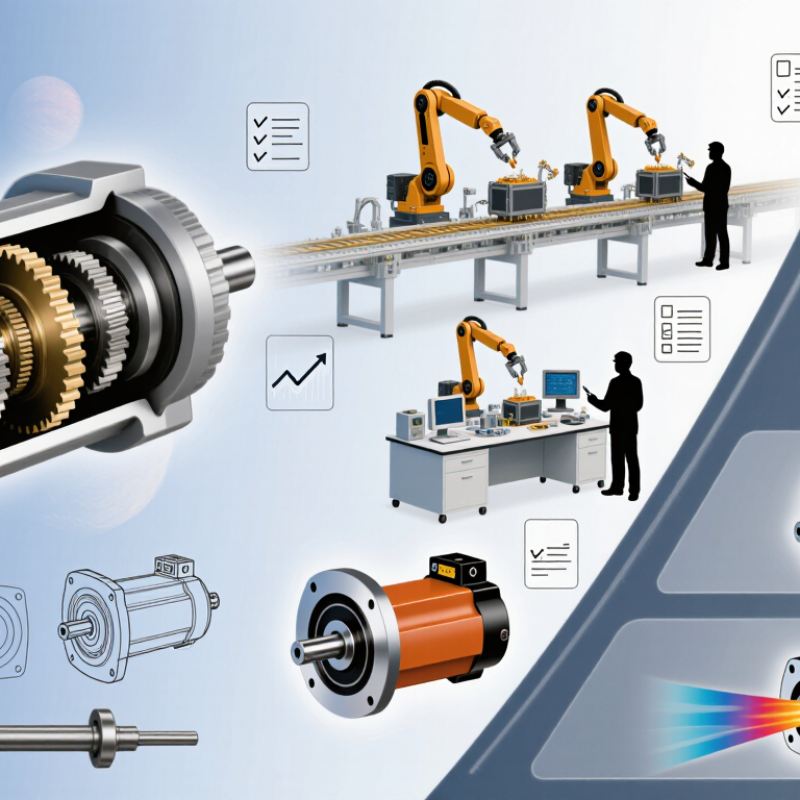
A DC planetary gear motor combines a direct-current motor with a planetary gearbox. The motor creates rotation. The gearbox reduces speed and increases usable torque. A compact assembly can drive a conveyor roller, robotic joint, valve, camera slider, or medical positioning mechanism.
Its gearbox usually contains a sun gear, several planet gears, a ring gear, and a carrier. The planet gears rotate around the sun gear while turning on their own axes. This arrangement spreads the load across multiple contact points. It also provides high torque in a relatively small housing. Engineers must check reduction ratio, rated voltage, continuous torque, peak torque, and output speed. Noise, backlash, shaft alignment, and thermal limits matter too.
Real selection work requires more than reading a catalogue. Measure the load at startup, not only during smooth operation. A motor that survives a brief peak may still overheat during repeated cycles. Ask suppliers for efficiency curves, gearbox material details, life-test conditions, and dimensional tolerances. Verify whether protection ratings apply to the complete motor or only its casing. That distinction is easy to miss. Environmental temperature, dust, mounting direction, and duty cycle can change performance significantly. In practice, a slightly larger motor may offer better reliability, but oversizing can increase cost, current draw, and mechanical stress. Supplier quality records and traceable inspection data deserve careful review.
How Do Gear Ratios and 90–95% Efficiency Affect Motor Performance?
China Top DC Planetary Gear Motor Suppliers: How to Choose?
Gear ratio directly shapes a DC planetary gear motor’s speed, torque, and operating noise. A 10:1 ratio can reduce a 3,000 rpm motor to about 300 rpm. Output torque rises, but gearbox losses reduce the usable value. The practical formula is simple: output torque equals motor torque multiplied by ratio and efficiency. At 95% efficiency, a 1 Nm motor can deliver about 9.5 Nm through a 10:1 gearbox. At 90%, the result falls to 9 Nm. Small differences become important in continuous-duty equipment.
The International Energy Agency reports that electric motor systems consume roughly half of global electricity. This makes efficiency more than a specification-sheet detail. However, suppliers should state test speed, load, temperature, and lubrication conditions. A claimed 90–95% efficiency may apply only near rated load. It may drop during light-load cycling. I have seen compact motors feel warm even when their published efficiency looked impressive. That deserves investigation.
A higher ratio is not always better. A 30:1 gearbox may provide strong lifting torque, yet acceleration becomes slower. Two reduction stages can multiply losses: 92% efficiency per stage becomes only 84.6% overall. The U.S. Department of Energy’s motor-system guidance also emphasizes matching motors to actual duty cycles, not peak ratings alone. Ask suppliers for measured torque-speed curves, backlash data, thermal limits, and endurance results. Certification helps, but real operating evidence matters more.
How Gear Ratios and 90–95% Efficiency Affect DC Planetary Gear Motor Performance
This chart uses a constant 3,000 rpm motor speed and 0.10 N·m input torque. Output speed decreases as the gear ratio increases, while output torque rises according to the selected ratio and gearbox efficiency. The efficiency values shown are representative engineering values for compact planetary gear stages.
Calculation basis: output speed = motor speed ÷ gear ratio; output torque = input torque × gear ratio × efficiency. Higher ratios provide greater torque multiplication but reduce output speed, while efficiency losses become more significant at extreme ratios.
How Can IP Ratings, IEC 60034-1, and ISO 9001 Verify Product Quality?
When choosing a China-based DC planetary gear motor supplier, examine evidence beyond torque charts and attractive prices. An IP rating indicates protection against dust and water under defined test conditions. IP65, for example, does not mean waterproof operation in every environment. Ask for the test standard, sample configuration, and inspection date.
IEC 60034-1 helps evaluate rated output, temperature rise, duty, insulation, and operating conditions for rotating electrical machines. It is useful, but it does not certify every gearbox detail. Check whether the supplier tests the complete motor and planetary assembly, not only the motor core. Request test records showing voltage, current, speed, noise, backlash, and temperature. Real production samples matter.
ISO 9001 demonstrates a documented quality management system. It can support traceability, corrective actions, supplier control, and process consistency. However, certification alone cannot guarantee reliable gear motors. Verify the certificate’s scope and validity. Review incoming-material checks, gear inspection methods, and final-load testing. A factory visit can reveal storage damage, unclear labels, or rushed assembly. These details are easy to miss. I would also compare three samples from different batches, because one excellent sample proves very little. Ask how failures are recorded and corrected. Honest answers often reveal more than polished brochures. Some specifications may remain unclear, especially under changing loads or high humidity. That uncertainty deserves a controlled test before bulk purchasing.
How Should Buyers Compare China Suppliers, Testing Data, Warranty, and Cost?
Choosing a China DC planetary gear motor supplier requires more than comparing catalog prices. Buyers should examine test data, warranty terms, and production controls together. Ask for torque, speed, noise, efficiency, and temperature-rise results under defined loads. The testing voltage and duty cycle should match your application. Numbers matter.
Request sample reports from recent production batches, not only laboratory prototypes. Check whether measurements use calibrated instruments and recorded tolerances. A supplier with engineering experience can explain gear material, lubrication, shaft play, and brush life clearly. If answers stay vague, the risk increases. One overlooked detail is connector quality, especially in equipment exposed to vibration or repeated movement.
Warranty documents should state coverage, exclusions, inspection steps, and response time. A twelve-month warranty means little without replacement procedures and traceable failure analysis. Compare total cost, including samples, tooling, shipping, inspection, and possible redesigns. The cheapest quotation may create expensive delays. I once focused too heavily on unit price and underestimated communication time; that mistake changed my evaluation method. Now I score suppliers by data quality, production consistency, technical response, and warranty evidence. A small pilot order can reveal assembly marks, inconsistent gearbox noise, or unstable output speed before full production. Perfect data is uncommon, but unexplained data is a serious warning.