What Is the Best China Crystal Table Supplier?

Choosing the best China Crystal Table supplier requires more than comparing online prices. A reliable supplier should combine refined design, stable production, transparent communication, and proven export experience. The ideal Crystal Table must look elegant under showroom lighting and remain secure during daily use. Details matter, including glass thickness, edge polishing, frame alignment, and protective packaging.

Experienced buyers should request clear product specifications before placing an order. Ask about tempered glass, load capacity, surface testing, and available finishes. A professional manufacturer can usually provide samples, factory photographs, inspection records, and practical shipping advice. Certifications may also support product reliability, but buyers should verify their authenticity and relevance to the destination market. Never rely on attractive catalog images alone.

The best China Crystal Table supplier is not always the cheapest option. A low quotation may hide weaker packaging, inconsistent materials, or costly replacement issues. Review response speed, production timelines, quality-control procedures, and after-sales support. If possible, inspect a sample under natural light and check every joint by hand. No supplier is perfect. Even experienced teams can overlook small defects. That is why written agreements, pre-shipment inspections, and realistic expectations remain essential. This guide compares important supplier qualities, helping importers choose with greater confidence, clearer evidence, and fewer avoidable surprises.
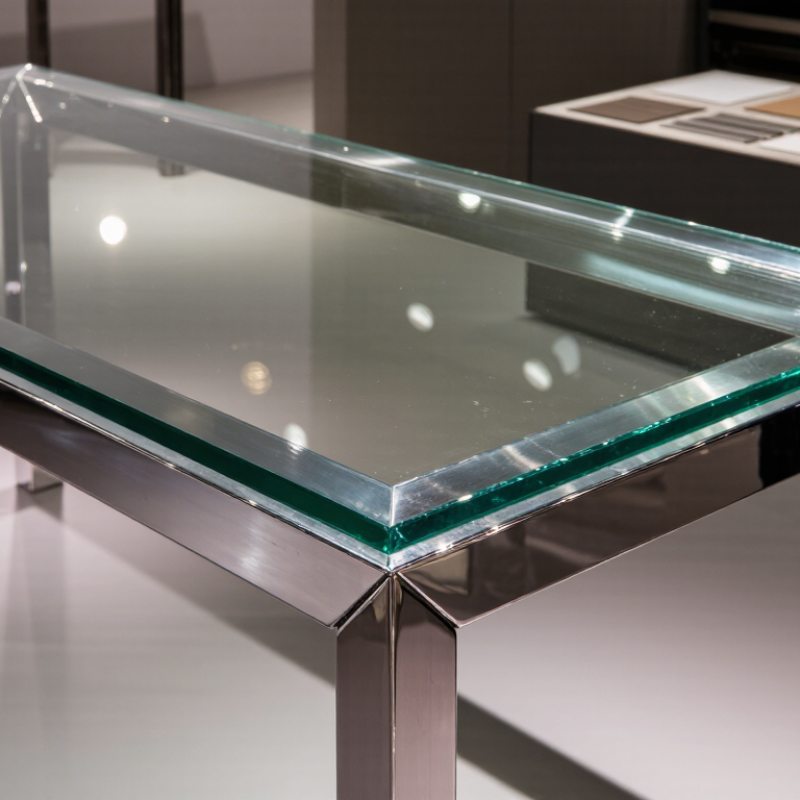
What Is the Best China Crystal Table Supplier?

Define Crystal Table Types, Materials, and Common 8–12 mm Glass Options

Choosing a China crystal table supplier starts with defining “crystal.” In furniture, the term often means clear glass, not mineral crystal. A supplier should state the glass composition, processing method, and intended use.

Common types include dining tables, coffee tables, side tables, console tables, and conference tables. Each type changes the required span, support structure, edge treatment, and safety testing.

A round dining top feels stable. A long conference top needs stronger support.

For everyday furniture, tempered glass is practical because it resists heat and impact better than ordinary annealed glass. Laminated glass adds a safety layer that helps retain fragments after breakage. Low-iron glass offers cleaner transparency, while frosted, tinted, and printed surfaces affect privacy and maintenance. Wood, stainless steel, aluminum, and stone can frame or support the glass. The joint design matters as much as the tabletop. Small details matter.

The most common options are 8 mm, 10 mm, and 12 mm glass.

Eight-millimeter glass suits compact side tables and shorter spans with proper support. Ten millimeters offers a balanced choice for many coffee and dining designs. Twelve millimeters provides greater stiffness for larger tops, but increases weight and handling demands.

Thickness alone does not prove quality. Ask for edge-polishing samples, flatness records, tempering results, tolerances, and packaging photos.

I once assumed a thicker top meant a safer table. That assumption was incomplete. Support spacing, corner protection, and installation control may matter more. Reliable suppliers explain these limits clearly.


Compare Tempered Glass Strength Claims of 4–5× Against Annealed Glass

When comparing China crystal table suppliers, treat the “4–5× stronger” claim as a starting point, not proof. Industry guidance commonly compares fully tempered glass with annealed glass under bending loads. ASTM C1048 specifies a minimum surface compression of about 69 MPa for fully tempered glass. That figure supports stronger performance, but it does not guarantee identical results for every tabletop.

The details matter. Glass thickness, edge finishing, holes, support spacing, and surface scratches can change failure risk. A 10 mm tempered panel with polished edges may perform differently from a drilled panel with a chipped corner. ANSI Z97.1 also focuses on safety glazing behavior, including fragmentation into smaller pieces after breakage. Safer failure is valuable. It is not the same as being unbreakable. I would ask suppliers for recent laboratory reports, heat-soak test records, and batch-level compression results. Ask for the test method, sample size, glass thickness, and loading direction. Vague certificates are not enough.

Some supplier claims still feel incomplete. They may quote a multiplier without explaining the test conditions. That deserves reflection. Reliable procurement should compare identical samples under identical loads, then inspect edges and packaging damage. A practical factory review should include random thickness checks, visual inspection under angled light, and records for each production batch. The strongest claim means little if the table arrives with a microscopic edge defect.

What Is the Best China Crystal Table Supplier? – Compare Tempered Glass Strength Claims of 4–5× Against Annealed Glass
Evaluation Dimension Annealed Glass Heat-Strengthened Glass Fully Tempered Glass What a Supplier Should Document
Typical surface compression Minimal; the glass retains its original annealed stress condition. Higher than annealed glass, but lower than fully tempered glass. Commonly at least 69 MPa under ASTM C1048 classification for fully tempered glass. Measured surface compression, test method, sampling plan, and inspection records.
Bending-strength comparison Baseline reference: approximately 40–55 MPa is commonly used for design-level soda-lime glass values, depending on surface condition and calculation method. Generally about 1.5–2 times the bending strength of comparable annealed glass. A “4–5 times stronger” claim can be reasonable as a general comparison with annealed glass, but it is not a universal guaranteed value. Strength depends strongly on edge quality, glass thickness, surface damage, and test conditions. Provide a standard-based test report rather than relying only on a marketing multiplier.
Breakage pattern Breaks into larger, sharp shards that may remain attached to the frame or surface. Breaks into larger pieces than fully tempered glass and may retain more dangerous edges. Breaks into many smaller, relatively blunt particles, reducing the risk of large cutting shards. Confirm compliance with the applicable safety-glazing requirement, such as EN 12150 or ASTM C1048.
Thermal-shock resistance Lower; rapid temperature changes can cause thermal fracture. Better than annealed glass and suitable for moderate thermal variation. Higher resistance to thermal shock than annealed glass because of the induced stress profile. Specify the intended temperature range and request thermal-shock or heat-soak test information where relevant.
Spontaneous breakage risk No nickel-sulfide inclusion risk created by tempering. Lower than fully tempered glass because the tempering level is reduced. Very small nickel-sulfide inclusions can cause delayed spontaneous breakage in some toughened glass. Heat-soak testing can reduce, but cannot absolutely eliminate, this risk. Ask whether heat-soak testing is available and request the applicable standard, batch records, and acceptance criteria.
Post-processing Can usually be cut, drilled, edged, or polished after manufacture. Must generally be cut, drilled, and edge-finished before heat treatment. All cutting, drilling, notching, and edge finishing must normally be completed before tempering. Require approved drawings before production and verify hole diameter, edge distance, corner radius, and tolerance controls.
Suitable table applications Low-risk decorative panels and applications where safety glazing is not required. Large panels requiring better thermal and mechanical performance with lower fragmentation risk than fully tempered glass. Common choice for dining tables, coffee tables, side tables, and other furniture tops where safety glazing is required. Match the glass type to the table design, support system, impact exposure, and local building or furniture-safety requirements.
Common thickness options Typically available in approximately 4–19 mm, subject to the processor’s equipment and size limits. Often available in approximately 4–19 mm, subject to production capability. Common furniture-top thicknesses include approximately 6, 8, 10, and 12 mm; thicker options may also be available. Confirm finished thickness, thickness tolerance, maximum panel size, flatness, and allowable edge or corner defects.
Surface appearance Usually has the lowest optical distortion when properly processed. May show moderate roller-wave or optical distortion after heat treatment. May show roller-wave distortion, anisotropy, or temporary iridescent patterns caused by the tempering process. Request approved samples, viewing-distance criteria, optical-quality limits, and a written defect-acceptance standard.
Laminated safety option Can be laminated with an interlayer to help retain fragments after breakage. Can be laminated, subject to the interlayer and processing specification. Tempered glass can be laminated to combine fragmentation safety with improved post-breakage retention. Specify interlayer type, nominal thickness, edge-seal requirements, humidity resistance, and delamination warranty terms.
Supplier comparison priority Lowest processing complexity, but limited safety performance. Balanced strength and lower distortion risk than fully tempered glass in some designs. Strong safety and impact-performance option, provided the supplier controls edges, holes, flatness, fragmentation, and tempering quality. Compare verified test reports, quality-control procedures, sample approval, packaging, replacement policy, and export documentation—not only the “4–5×” claim.
Important interpretation: The 4–5× figure is a broad industry comparison, not a guaranteed value for every panel. Actual glass strength can be substantially affected by edge damage, holes, scratches, support spacing, impact location, panel dimensions, and the selected design standard.
Reference framework: ASTM C1048 for heat-treated flat glass, EN 12150 for thermally toughened soda-lime silicate safety glass, and standard engineering design practice for load, impact, edge, and support evaluation. Values should be verified against the specific product test report and destination-market requirements.

Verify EN 12150, ASTM C1048, and GB/T 3324 Compliance

What Is the Best China Crystal Table Supplier?

A reliable China crystal table supplier should prove compliance, not simply print standards on a catalogue. EN 12150 applies to thermally toughened soda-lime safety glass. Ask for test reports showing glass thickness, heat-soak treatment, fragmentation results, and production dates. ASTM C1048 covers heat-treated flat glass, including tempered and heat-strengthened types. The report should identify the test method, specimen size, and laboratory.

Vague certificates are warning signs.

GB/T 3324 requires closer checking. It mainly addresses general technical conditions for wooden furniture, so its relevance depends on the table’s frame and wood components. Request a written scope statement. Confirm whether the certificate covers the complete table, only the wooden structure, or neither.

During inspections, check polished edges, corner protection, drilled holes, welds, and the contact points beneath the glass.

A tiny edge chip can become a serious failure after installation.

Tips: Request original reports, not cropped screenshots. Match the report’s factory address with the actual production site. Ask for a recent sample and compare its glass marking, thickness, and dimensions.

Packaging also matters; use corner guards, foam separation, and a shock-resistant crate. In my experience, suppliers often discuss glass strength but overlook frame movement. That gap deserves attention. Standards help, but traceable testing and careful inspection make the decision more reliable.

Evaluate Suppliers Through ISO 9001, MOQ, Lead Time, and Export Data

What Is the Best China Crystal Table Supplier?

Evaluate suppliers beyond attractive product photos. ISO 9001 should be verified through a current certificate, scope, and issuing body. The ISO Survey 2023 reported more than 1.26 million ISO 9001 certificates worldwide. Still, certification does not guarantee flawless crystal tables. Request inspection records for polishing, edge thickness, base stability, and packaging damage.

MOQ and lead time reveal operational fit. Ask for separate MOQs by design, size, and color. A supplier quoting 100 pieces may require 100 pieces per variation. That changes the real cost quickly. For standard crystal tables, 25–45 days is a practical planning range after artwork approval. Custom molds can add several weeks. Get production and shipping dates in writing. The World Bank’s 2023 Logistics Performance Index gave China a 3.7 score out of 5, but port congestion and holiday closures still affect delivery.

Tips: Compare three written quotations. Check whether prices include cartons, pallets, inspection, and export documents. Review the supplier’s recent export history through UN Comtrade HS 7013 glassware records; China remains a major exporter in this category. Ask for two recent shipment references, not only certificates. I would also test one sample under real use. A beautiful sample can hide weak joints, uneven plating, or poor foam protection. That is an easy mistake.

Rank China Suppliers by Testing, Customization, Warranty, and Total Cost

What Is the Best China Crystal Table Supplier?

The best supplier is not always the factory with the lowest quotation. A practical ranking should begin with testing. Ask for glass thickness, load capacity, edge treatment, and stability reports. Request samples from the same production line. A polished sample can hide uneven joints. Inspect welds, crystal clarity, coating adhesion, and packaging strength under normal handling.

Customization separates capable suppliers from simple traders. Strong suppliers can adjust dimensions, colors, hardware, logos, and packing methods without losing production consistency. Confirm the drawing process before placing an order. Technical drawings should show tolerances, hole positions, and surface requirements. One missing measurement can create expensive rework. I have found that fast replies do not always indicate strong engineering support.

Warranty terms deserve a clear ranking. Check coverage for cracks, corrosion, loose fittings, and transport damage. Ask who pays for replacement parts and how claims are documented. Then calculate total cost, including tooling, sample fees, inspection, freight, duties, storage, and possible repairs. The cheapest unit price may become the highest landed cost. A reliable supplier provides written timelines and realistic production capacity. Even careful evaluations can be imperfect. Seasonal delays, packaging changes, and unclear responsibility may still affect results. Keep every approval in writing.

Members of