How to Choose EVA Puzzle Mats for Global Buyers?
Choosing EVA Puzzle Mats for global buyers requires more than comparing colors, thickness, and carton prices. The right decision begins with the intended environment. A children’s playroom, fitness studio, trade booth, and warehouse require different performance levels. A soft 10-millimeter mat may feel comfortable under bare feet, yet it can compress quickly beneath heavy gym equipment.
Elena Marquez, a senior EVA flooring consultant, states, “A reliable mat starts with verified material quality, not attractive packaging.” Her point matters during international purchasing. Buyers should request product specifications, density information, dimensional tolerances, odor testing, and surface-slip data. They should also examine how tightly the puzzle edges connect after repeated assembly. Small gaps can collect dust and become visible after several cleaning cycles.
Material safety documentation deserves careful attention. Requirements differ between markets, so suppliers should provide test reports relevant to the destination country. Buyers can ask about restricted substances, fire behavior, cleaning resistance, and packaging materials. A clear batch number also supports traceability when quality problems appear.
Climate can change performance. In a humid coastal warehouse, poorly packed EVA Puzzle Mats may absorb surface moisture or develop unpleasant odors. In a hot container, dark colors may expand slightly and distort interlocking edges. This possibility is often underestimated.
Price still matters. However, the lowest quotation may hide thinner foam, inconsistent density, or weak cartons. No checklist is flawless. Samples should be assembled, walked on, cleaned, and stored before a large order is approved. That practical test often reveals what a specification sheet cannot.
What Are EVA Puzzle Mats and How Are They Used?
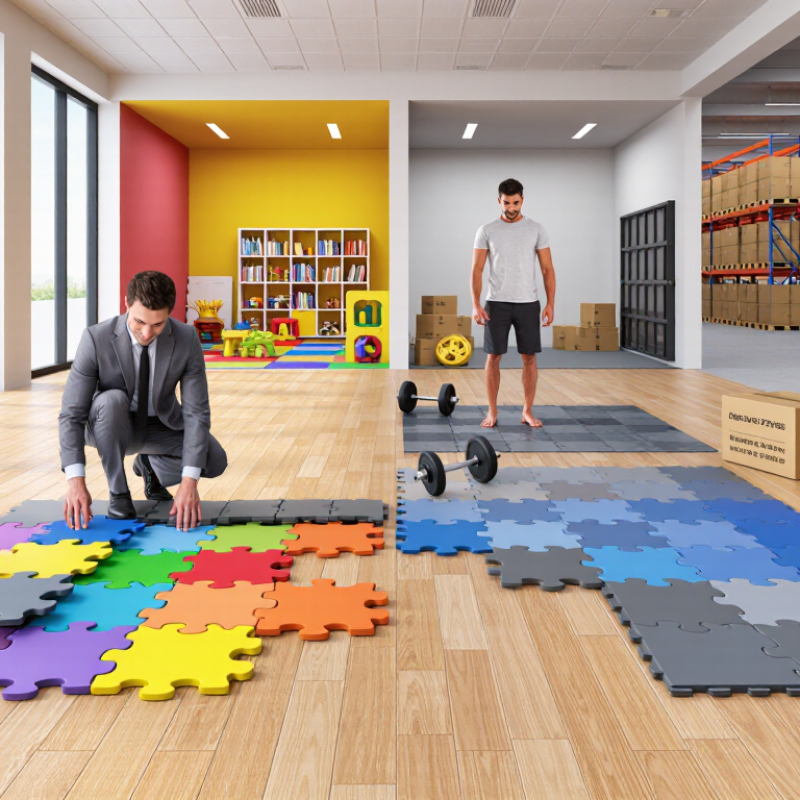
EVA puzzle mats are interlocking foam tiles made from ethylene-vinyl acetate. Their edges connect like simple floor puzzle pieces. This design allows global buyers to cover different room sizes without permanent installation. The foam surface cushions movement, reduces contact with cold floors, and softens minor impacts. They are commonly used in nurseries, playrooms, home gyms, classrooms, and temporary activity areas.
A buyer should match the mat to its actual environment. For children’s spaces, check surface texture, edge quality, odor, and cleaning instructions. For exercise areas, thickness and compression recovery matter more. A thicker tile is not always better. Soft foam may feel comfortable but become unstable under heavy equipment. In practical sourcing, I would request samples and press them repeatedly before approving a large order.
Dimensions, density, interlocking accuracy, and packaging affect international purchasing. Ask for material declarations, test reports, and clear product specifications. Local requirements may differ, so documents should be checked for the destination market. Temperature changes during shipping can also influence foam flexibility and odor. A sealed carton is useful, but ventilation may still be needed after opening. Matte surfaces often hide dust better, although they can be harder to wipe completely. That small compromise deserves attention.
Which EVA Materials and Safety Standards Should Buyers Check?
Global buyers should treat EVA puzzle mats as tested consumer products, not simple foam tiles. Material grade matters. Closed-cell EVA usually resists water and absorbs impact, but density, hardness, and odor can vary between batches. Ask for the EVA composition, foam density, thickness tolerance, and colorant details. A low price may hide weaker interlocking edges or excessive surface abrasion.
Safety documents deserve closer checking. For children’s products, request test reports covering ASTM F963 or EN 71, depending on the destination market. EN 71-3 evaluates the migration of specific elements, including certain heavy metals. In the European Union, also check REACH SVHC screening. The European Chemicals Agency listed 241 substances on its Candidate List in June 2024. For the United States, verify applicable CPSIA limits for lead and phthalates. Formamide testing may also be sensible for foam products, although requirements differ by market. A certificate alone is not proof. Match it with the exact factory, product code, and production batch.
Tips: Request samples from three production batches. Test odor after opening and again after 72 hours. Measure thickness at several points. Keep photos of packaging labels and laboratory seals. Reports from recognized laboratories are useful, but they can still miss a changed raw-material supplier. I would also check slip resistance on a dry and slightly damp surface. It is an imperfect test, yet real homes are imperfect too.
Source: European Chemicals Agency Candidate List, June 2024; U.S. Consumer Product Safety Commission, CPSIA guidance; ASTM F963 and EN 71 test frameworks.
How to Evaluate Suppliers, Customization, Packaging, and Certifications?
How to Choose EVA Puzzle Mats for Global Buyers?
Supplier evaluation should begin with traceable production evidence, not attractive samples. Ask for factory audit records, material specifications, batch numbers, and recent test reports. The 2024 Grand View Research analysis identifies construction and packaging as major EVA foam applications, reflecting steady demand for lightweight, shock-absorbing products. However, market reports are broad. They do not prove one supplier’s consistency. Request samples from three production batches. Check odor, density, edge cutting, interlocking accuracy, and color variation after 48 hours.
Tips: Confirm the EVA grade and thickness in writing. Request tests for heavy metals, phthalates, migration, and flammability where applicable. For children’s products, review relevant EN 71, ASTM F963, or ISO 8124 requirements. A certificate without a matching report is weak evidence. Also inspect the laboratory’s accreditation and report date.
Customization can include thickness, surface texture, logo placement, carton size, and printed instructions. Measure the assembled mat, not only one tile. A small tolerance may create visible gaps across a large floor. Packaging deserves equal attention. Export cartons should resist compression, moisture, and rough handling. The International Safe Transit Association recommends performance-based package testing, but many buyers still rely on visual checks. That is a mistake. Use drop, vibration, and compression tests for your actual carton design. I would also leave space for improvement. First samples often look perfect, while mass production reveals odor, shrinkage, or inconsistent locking. Supplier promises matter less than repeatable records.
How to Choose EVA Puzzle Mats for Global Buyers?
This suggested evaluation framework assigns the highest priority to product safety and supplier capability, followed by customization, packaging and logistics, and certifications. Buyers should verify test reports, material specifications, production consistency, export packaging, and documentation before placing an order.
How to Compare Costs, Shipping Terms, and Quality Before Ordering?
How to Choose EVA Puzzle Mats for Global Buyers?
How to Compare Costs, Shipping Terms, and Quality Before Ordering?
A low unit price can hide expensive problems. Compare the landed cost, not only the factory quotation. Include product price, packaging, inland delivery, freight, insurance, duties, and local handling fees. Ask suppliers to quote the same quantity and packaging standard. Otherwise, the comparison is unreliable.
Shipping terms need careful attention. Under different Incoterms, the buyer may control freight, customs clearance, or final delivery. Confirm the named destination, transfer of risk, and included charges in writing. Check carton dimensions and gross weight, because bulky EVA mats can cost more by volume than by weight. Request a sample freight calculation before placing a large order.
Quality should be measured, not assumed. Inspect thickness, density, surface texture, edge cutting, and interlocking accuracy. A 10 mm mat should not vary noticeably across the sheet. Check whether pieces separate after repeated assembly. Smell matters too. Strong odor after airing may indicate poor material control. Ask for test reports, but verify that they match the actual production batch.
Do not trust perfect samples alone. Mass production can differ. Require a pre-shipment inspection or clear acceptance criteria. I have seen buyers focus too heavily on price and overlook replacement costs. That mistake is understandable, but avoidable. A slightly higher quote may deliver better consistency, safer packaging, and fewer customer complaints.