How to Choose the Right Industrial Compressor for Your Business Needs
In today's fast-paced industrial landscape, selecting the right industrial compressor is crucial for optimizing operational efficiency and ensuring sustainable productivity. According to the latest report from Research and Markets, the global industrial compressor market is projected to reach $35 billion by 2025, driven by the increasing demand from various sectors, including manufacturing, oil and gas, and food and beverage. Understanding the specific needs of your business, such as air quality, volume requirements, and energy efficiency, is essential to making an informed decision.
Industry expert John Smith, a renowned consultant in the field of pneumatic systems, emphasizes the significance of this choice: "Choosing the right industrial compressor can mean the difference between smooth operations and costly downtimes." His insights resonate with many businesses that depend on reliable air supply systems. As companies navigate through diverse operational environments, the challenge remains to identify compressors that not only meet their technical requirements but also enhance their overall productivity and profitability.
As advancements in technology lead to the development of more efficient and environmentally friendly compressors, understanding the nuances of each type—from reciprocating to rotary screw compressors—becomes imperative. This guide will help navigate the complex landscape of industrial compressors and empower businesses to select the optimal solution tailored to their unique operational needs.
Understanding Different Types of Industrial Compressors
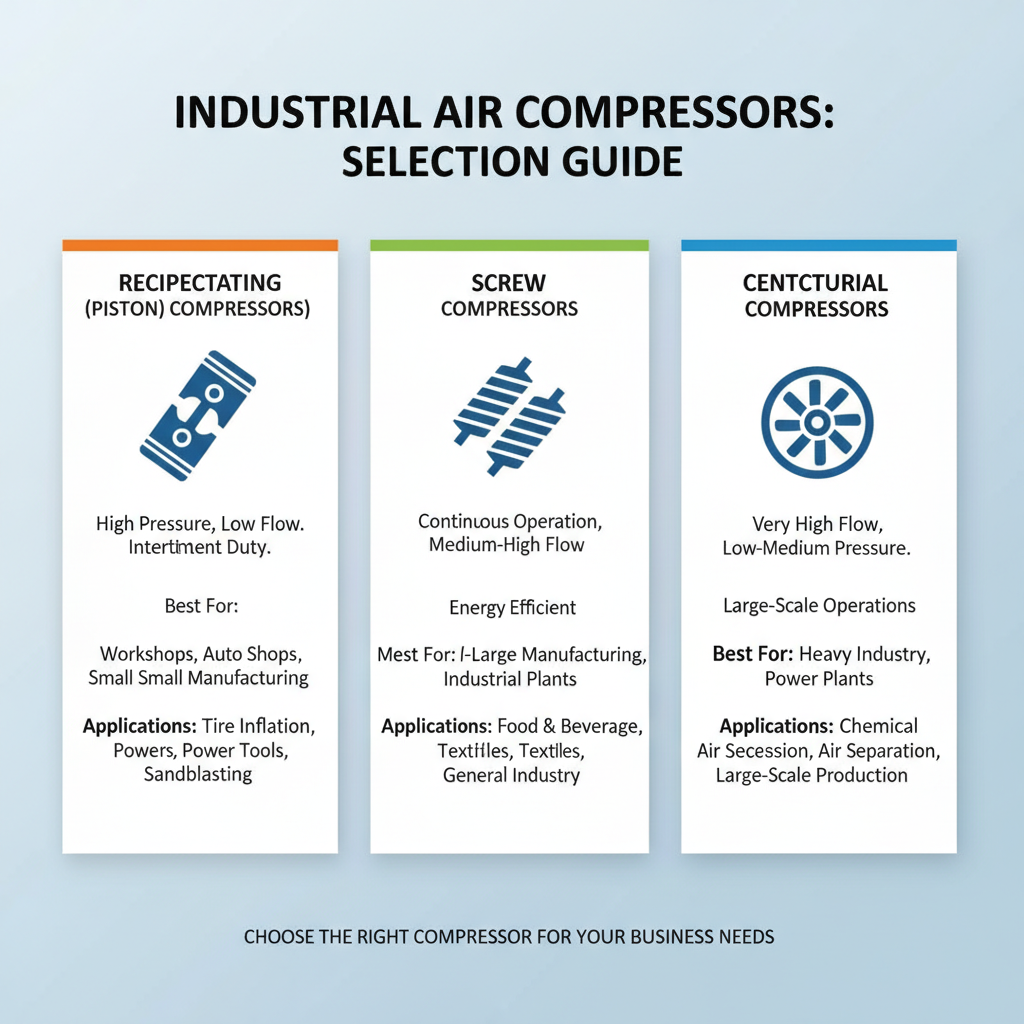
When selecting the right industrial compressor for your business needs, it's essential to understand the different types available on the market. The primary categories include reciprocating air compressors, screw air compressors, and centrifugal air compressors. Each type has distinct characteristics suited for various applications. For instance, reciprocating compressors are ideal for applications requiring high pressure and low flow, while screw compressors are efficient for continuous operations. Centrifugal compressors, on the other hand, are favored in large-scale operations due to their ability to handle high volumes of air.
Tips: Consider the nature of your operations when choosing a compressor. Evaluate factors such as pressure requirements, flow rate, and efficiency. If your business relies heavily on continuous air supply, investing in a screw compressor might be the most beneficial, while for high-peak demands, a reciprocating compressor could be a better choice. Also, assess the maintenance needs and energy consumption of each type to ensure long-term efficiency and cost-effectiveness.
Moreover, understanding the growth trends in the industrial compressor market is critical. The global market for centrifugal compressors is projected to grow significantly, driven by the increasing demand for air and gas compression across various industries. Furthermore, factors such as the rise in mining, chemical production, and refrigeration systems are shaping the landscape. Thus, staying informed about market dynamics can aid in making a more informed decision tailored to your specific business requirements.
Assessing Your Business's Compressed Air Requirements
When selecting the appropriate industrial compressor for your business, it's crucial to first assess your compressed air requirements. The growth of the global air compressor market, projected to increase from $18.96 billion in 2025 to $29.31 billion by 2032 at a compound annual growth rate (CAGR) of 6.4%, emphasizes the rising importance of efficient air compression in various industries. Understanding your specific needs will help in determining the type and size of compressor necessary to support your operations effectively.
Factors to consider include the volume of compressed air your processes require, the pressure levels needed, and the overall energy efficiency of the compressor. With industries evolving rapidly and compliance standards becoming stricter, as seen in the context of India's industrial safety regulations, businesses must make informed decisions to ensure both operational success and adherence to regulatory requirements. Conducting a thorough assessment of your compressed air requirements will not only help in selecting the right compressor but will also contribute to long-term sustainability and cost savings.
Key Factors to Consider When Selecting a Compressor
When selecting the right industrial compressor for your business needs, several key factors must be considered to ensure optimal performance and efficiency. One crucial aspect is the required air quality. According to the Compressed Air and Gas Institute (CAGI), over 70% of all manufacturing facilities rely on compressed air, yet many do not account for the necessary air quality required for their specific applications. For example, food and beverage industries require oil-free air to maintain hygiene standards, while other sectors may only need standard industrial air.
Energy efficiency is another vital consideration, as compressors can significantly impact a company's operational costs. The U.S. Department of Energy (DOE) estimates that air compressors can account for 10% of a facility's total energy consumption. Selecting a variable speed drive compressor can lead to energy savings of up to 50%, as it adjusts the motor speed to match the airflow demand. Furthermore, understanding duty cycles and pressure requirements is essential, as continuous-duty compressors may be needed for high-demand applications, while intermittent-duty models may suffice for less demanding tasks. Making informed choices based on these factors can enhance productivity and reduce overhead costs.
Industrial Compressor Types and Their Applications
Evaluating Energy Efficiency and Operational Costs
When choosing an industrial compressor, energy efficiency is a critical factor that can significantly impact operational costs. Modern compressors offer a variety of energy-saving features, such as variable speed drives and advanced control systems, which can adjust the compressor's output to match the actual demand. This dynamic operation reduces energy waste and can lead to substantial savings over time. Businesses should carefully assess the energy consumption ratings of different models, as well as consider the total cost of ownership, which includes maintenance and energy expenses.
Additionally, evaluating the operational costs entails understanding the compressor's performance under varying load conditions. Compressors that operate efficiently at both full and partial loads can enhance energy savings further. It's essential to calculate the expected duty cycle and select a compressor that can perform optimally at those specific conditions. Long-term reliability and reduced downtime related to maintenance should also be factored into the decision, as these elements contribute to the overall cost-effectiveness of the equipment. By prioritizing energy efficiency and evaluating operational costs, businesses can make informed choices that align with their financial goals while supporting sustainable practices.
How to Choose the Right Industrial Compressor for Your Business Needs - Evaluating Energy Efficiency and Operational Costs
| Compressor Type |
Energy Efficiency Rating (kW/m³/min) |
Operational Cost per Hour ($) |
Maintenance Frequency (Months) |
Typical Use Cases |
| Reciprocating Compressor |
0.09 |
$2.50 |
6 |
Manufacturing, Automotive Repair |
| Rotary Screw Compressor |
0.07 |
$3.00 |
12 |
HVAC, Food Processing |
| Centrifugal Compressor |
0.05 |
$4.00 |
18 |
Chemical Processing, Oil & Gas |
| Scroll Compressor |
0.08 |
$2.70 |
8 |
Refrigeration, Air Conditioning |
| Oil-Free Compressor |
0.06 |
$2.20 |
12 |
Pharmaceuticals, Food & Beverage |
Maintenance and Support for Your Chosen Compressor
When choosing the right industrial compressor for your business, maintenance and support are critical factors that can greatly influence your overall operational efficiency. Recent developments in the industry highlight the importance of reliable service networks. For instance, the establishment of new service centers by various companies across North America signifies a growing commitment to providing comprehensive support. These centers not only facilitate routine maintenance but also ensure quick response times for repairs, thereby minimizing equipment downtime.
In addition to local service availability, predictive maintenance technologies are becoming increasingly important. Solutions that enhance maintenance efficiency by significantly reducing unplanned downtime can transform how businesses manage their compressor systems. By leveraging these technologies, companies can proactively address potential issues before they disrupt operations. Overall, ensuring that you select a compressor partner with robust maintenance capabilities will support long-term reliability and productivity in your business.