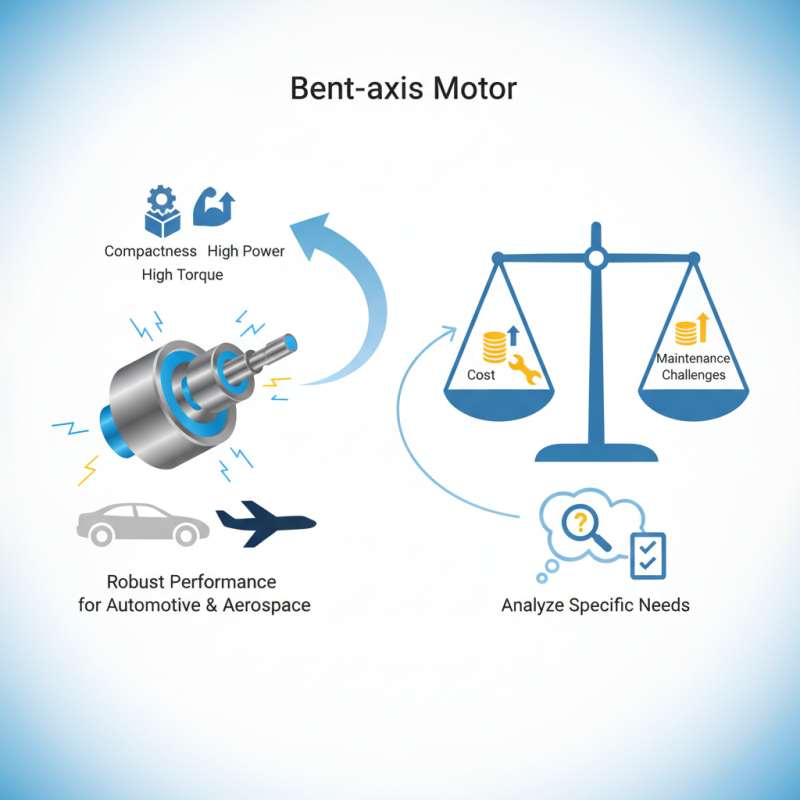
When selecting a motor for your application, it's crucial to consider various factors. The Bent-axis Motor stands out for its unique design and efficiency. Its angled shaft allows for a more compact setup, which can be a game changer in constrained spaces.
The Bent-axis Motor delivers high power and torque. This makes it an ideal choice for applications requiring robust performance. Industries, such as automotive and aerospace, benefit immensely from its reliability. However, it’s essential to analyze specific needs before making a decision.
While the Bent-axis Motor offers impressive benefits, there are challenges to consider. Cost and maintenance might become concerns over time. Users should weigh these factors against the motor's advantages before committing. Each application presents its own demands, and understanding these is key to making an informed choice.
Bent-axis motors are gaining traction in various applications due to their unique operational efficiency. These motors function by orienting the axis of the cylinder at an angle to the drive axis, improving energy transfer. This design feature helps achieve higher torque and efficiency compared to traditional motor types. According to industry reports, bent-axis motors can reach efficiencies of over 90% in ideal conditions, which translates into significant energy savings for manufacturers.
The operational mechanism of bent-axis motors allows them to handle higher pressures and speeds. For instance, they are capable of operating effectively in the range of 3000 to 5000 psi. This capability makes them suitable for demanding environments such as heavy machinery and aerospace applications. However, it is essential to consider that, despite these advantages, bent-axis motors can present complications. They typically require precise alignment and calibration, which can lead to increased installation costs.
Moreover, their design may lead to complexities in maintenance. Making adjustments can be more involved, especially for those unfamiliar with the technology. While bent-axis motors show exceptional performance, understanding their limitations is crucial for optimal application. Industry statistics highlight that 15% of users faced challenges in maintenance procedures, underscoring the importance of proper training and expertise.

Bent-axis motors offer unique advantages in various applications. These motors are designed to provide high efficiency and reliability. Their simple design enables easier maintenance, making them a favorite among engineers. They also excel in situations where compact size is essential. A smaller footprint means more space for other components.
One major benefit is their high torque at low speeds. This characteristic is particularly useful in hydraulic systems. In environments requiring precise control, bent-axis motors shine. They provide smooth operation, which is crucial for sensitive applications. However, one must consider that the initial cost may be higher. Are the long-term savings enough to justify this expense?
Another aspect worth noting is their adaptability. Bent-axis motors can fit into various systems without major modifications. This flexibility can streamline the design process. However, it’s important to assess the requirements fully. Will choosing this type of motor meet all your needs? Reflection on these questions is essential for making the right choice.
| Feature | Bent-axis Motors | Other Types of Motors |
|---|---|---|
| Efficiency | High, with minimal energy loss | Moderate, energy loss may be significant |
| Power Density | High power-to-weight ratio | Lower power density |
| Maintenance | Low, fewer moving parts | Higher maintenance requirements |
| Torque Output | High torque at low speeds | Variable torque performance |
| Operating Range | Wide operating range | Limited operating range |
| Noise Levels | Typically low noise operation | Can be noisy under load |
Bent-axis motors shine in various applications, particularly where high efficiency and compact design are crucial. One notable area is mobile machinery. Vehicles like excavators and forklifts benefit from their robust torque. These motors provide excellent performance even in tight spaces, allowing for versatile designs in construction equipment.
Another realm where bent-axis motors excel is in renewable energy. Wind turbines, for instance, utilize them for efficient energy conversion. The compactness of these motors enables optimal integration within generator systems, resulting in higher energy output. However, challenges arise with heat management during prolonged operation, requiring operators to monitor performance closely.
Hydraulic systems also leverage the advantages of bent-axis motors. They offer precise control and rapid response times. In industrial automation, efficiency is paramount. Yet, ensuring that every component works seamlessly can be complex. Regular maintenance and inspections are essential here, which can often be overlooked. Balancing efficiency with reliability requires continuous attention.
When selecting a bent-axis motor for your application, several factors come into play. Efficiency is critical. Research indicates that bent-axis motors can achieve efficiencies ranging from 90% to 98%. This high efficiency translates into reduced energy costs over time. In industries where energy consumption is a major concern, this can lead to substantial savings.
Another important aspect is the motor's size and weight. Bent-axis motors often have a compact design, making them ideal for applications with limited space. For instance, in mobile machinery, reducing weight can improve fuel efficiency. However, while they offer a compact form, one must also consider cooling requirements. Insufficient cooling may lead to performance issues and increased maintenance.
It is also essential to evaluate the operating conditions. Bent-axis motors perform well in variable-speed applications, but their performance can decline under extreme temperatures or high loads. Potential users should assess the specific demands of their environment. Testing in real-world settings could reveal unexpected challenges, such as vibration or noise levels. Continuous monitoring and adjustments may be necessary to address these issues effectively.
When it comes to bent-axis motors, maintenance is key. Regular checks can significantly extend their lifespan. A report by the International Hydraulics Institute states that proper maintenance can improve efficiency by up to 20%. This is crucial, especially in high-demand applications. Industrial sectors are increasingly relying on these motors for their durability and performance.
Performance optimization is another aspect to consider. Bent-axis motors typically offer a higher power-to-weight ratio. However, improper tuning can lead to inefficiencies. Some users report a 15% decrease in performance due to misalignment. Ensuring proper installation and alignment is vital. Even small deviations can affect torque and speed.
The data suggests that consistent monitoring is essential. Implementing predictive maintenance can reduce unexpected downtimes. This allows for timely interventions before issues escalate. The right sensors and software tools can help in monitoring performance parameters efficiently. Without these optimizations, the full potential of bent-axis motors may not be realized. This requires a proactive approach to maintenance and performance assessments.
This bar chart provides a visual comparison of the key performance metrics for bent-axis motors, showcasing their efficiency, power output, and maintenance frequency, which highlight the advantages of adopting such systems in various applications.
Please share your email with us to see your results.