Space heating is one of the biggest household energy uses. The U.S. Energy Information Administration’s 2020 Residential Energy Consumption Survey reports that it accounted for about 42% of residential energy consumption. That figure makes system design worth careful attention. Hydronic Heat Transfer Plates help move heat from tubing into a floor assembly, but results depend on the whole installation—not just the plate.
The U.S. Department of Energy’s Energy Saver guidance explains that radiant floor heating delivers warmth through floor surfaces, while ASHRAE’s HVAC Systems and Equipment Handbook provides technical guidance on radiant heating design. Neither source suggests that a particular plate guarantees lower bills. That matters. Plate material, thickness, tube fit, subfloor construction, insulation, and water temperature can all affect heat delivery. A plate that feels sturdy in your hand may still fit poorly around your chosen tubing.
This guide compares seven options by practical details: aluminum construction, channel design, installation method, compatibility, and available product documentation. We also consider where each type may fall short. No single model suits every floor. The best choice for a compact joist bay may not be the right one for a wide, open assembly. Treat manufacturer performance claims as starting points, not promises; project conditions can change the outcome.
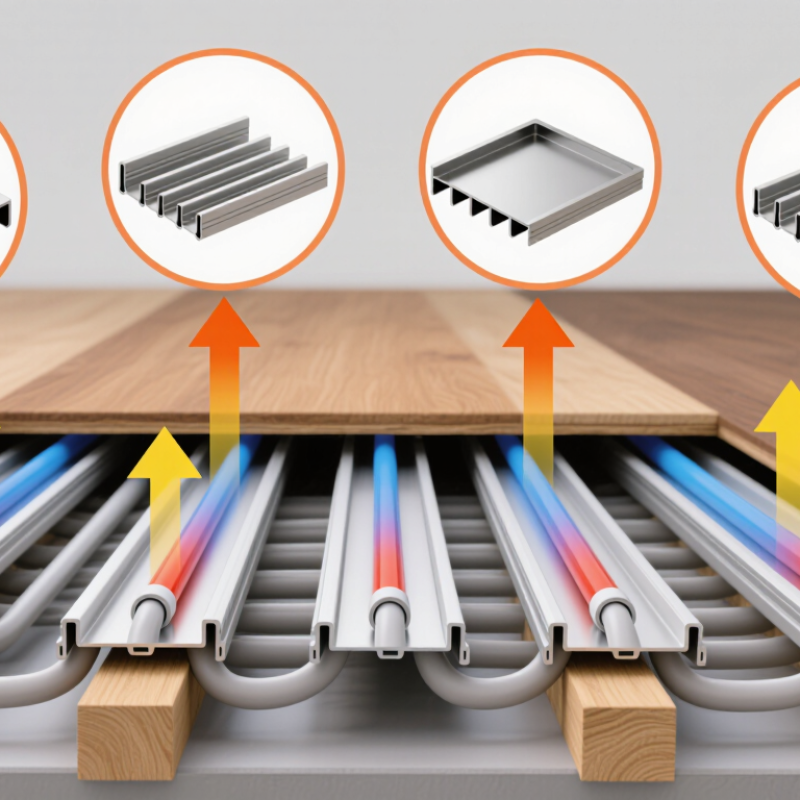
Hydronic heat-transfer plates sit between warm-water tubing and the floor structure. Their shaped channels hold the tubing against a broad metal surface, usually aluminum. That surface spreads heat sideways, reducing the hot-and-cool stripes that can occur when tubing warms only narrow strips of subfloor. In a joist bay, a well-fitted plate should contact the tubing and subfloor closely. Gaps matter.
The U.S. Energy Information Administration’s 2020 Residential Energy Consumption Survey reports that space heating accounted for about 42% of household energy use. That figure covers homes with many heating systems; it does not prove that plates alone save energy. It does show why distribution deserves attention. Plates can help transfer heat more evenly, but actual floor output also depends on water temperature, tube spacing, insulation, and floor coverings.
A thick rug can slow heat reaching the room. So can a loose plate or a poorly insulated cavity. The plate is not a heat source. It is a heat pathway. Installers should check tube fit, subfloor contact, and the design water temperature rather than assuming more metal guarantees better performance. A useful detail to reconsider: even a carefully installed system may feel uneven if the floor finish varies from room to room.
| Plate Type | Typical Tubing Fit | Design and Coverage | Best Suited For | Key Advantages | Installation Considerations |
|---|---|---|---|---|---|
| Heavy-Gauge Extruded Single-Channel Plate | Commonly made for 1/2-inch nominal PEX; confirm the groove matches the tubing specification. | Rigid aluminum profile with one formed channel that holds tubing against the plate. | Staple-up systems where consistent tube contact and sturdy construction are priorities. | Helps spread heat across more of the plate than tubing alone and resists bending during handling. | Secure the plate firmly to the subfloor or joists as specified. Avoid crushing or deforming the channel. |
| Standard Stamped Single-Channel Plate | Commonly available for 1/2-inch nominal PEX; check the product’s stated tubing compatibility. | Thin, formed aluminum plate with one tube channel; lengths and widths vary by product. | Typical joist-bay staple-up installations and projects balancing coverage with material cost. | Lightweight and straightforward to cut or fit around many common framing layouts. | Keep the plate in close contact with the subfloor. Follow the specified fastening pattern and tube spacing. |
| Double-Channel Plate | Usually designed for two runs of a specified tubing size, often 1/2-inch nominal PEX. | Two parallel grooves hold separate tubing runs at a fixed spacing. | Layouts that need two adjacent runs in a joist bay or a planned, repeatable tube arrangement. | Can simplify alignment and maintain consistent spacing between the paired tube runs. | Check the plate’s channel spacing against the hydronic design. Do not force tubing into an incompatible groove. |
| Wide-Format Stamped Plate | Made in tubing-specific versions, commonly for 1/2-inch nominal PEX. | A broader plate surface surrounds a single tube channel to distribute heat over a wider area. | Staple-up floors where broader plate coverage is desired and framing dimensions allow it. | Provides more aluminum contact area than a narrow plate of similar channel design. | Measure joist-bay clearances first; wider plates may need trimming or may not fit narrow or obstructed bays. |
| Narrow Plate for 3/8-Inch Tubing | Designed specifically for 3/8-inch nominal tubing. | Compact channel and plate profile for smaller-diameter tube. | Tight joist bays, smaller circuits, or layouts designed around 3/8-inch tubing. | Fits spaces where a wider plate or larger tubing may be difficult to accommodate. | Smaller tubing has different flow and circuit-design requirements; size the system accordingly and verify channel fit. |
| Deep-Channel Plate for 5/8-Inch Tubing | Designed for compatible 5/8-inch nominal tubing. | Deeper formed groove accommodates larger-diameter tubing than a standard 1/2-inch plate. | Systems specifically designed around larger tubing and matching plate profiles. | Provides a channel profile intended to hold the larger tube securely. | Confirm both the tubing’s nominal size and the plate’s specified groove dimensions before ordering or installing. |
| Full-Contact Wrap-Around Plate | Available in tubing-specific profiles; compatibility varies by design. | Channel geometry grips more of the tube circumference than a shallow, open channel. | Installations where secure tube retention and close plate-to-tube contact are important. | Helps maintain tube contact with the conductive plate and can reduce movement in the channel. | Use the tubing size and insertion method specified for the plate. Avoid damaging the tube while seating it. |
How the plates work: Hydronic tubing carries warm water beneath the floor. An aluminum transfer plate contacts the tubing and spreads heat over a larger area, helping transfer warmth to the subfloor. Plate dimensions, tubing fit, heat output, and installation requirements vary by product and system design; verify compatibility and follow the manufacturer’s instructions.