For global buyers, choosing the right Galvanized Pipe in 2026 requires more than comparing price per ton. Pipe type, zinc coating, manufacturing method, and destination standards all affect service life. Hot-dip galvanized pipe remains a practical choice for outdoor water lines, structural frames, agricultural systems, and industrial supports. Pre-galvanized and electro-galvanized options may suit lighter applications, but their coating thickness and edge protection require closer review.
Details matter.
A reliable purchasing process begins with the intended environment. Coastal air, buried soil, high humidity, and indoor service create different corrosion risks. Buyers should confirm nominal size, wall thickness, steel grade, connection method, and coating mass. Documents should reference applicable requirements, such as ASTM A53, EN standards, or ISO 1461, depending on the project location. A mill test certificate, coating inspection report, dimensional check, and sample photographs can reveal problems before shipment. Thread quality matters too. Damaged threads often create leaks, delays, and unnecessary field repairs.
The best choice is not always the heaviest pipe. Excess zinc can increase cost and affect handling, while insufficient coating may shorten service life. This balance is easy to underestimate. Experienced suppliers should explain tolerances, packaging methods, bundle markings, and realistic lead times. Buyers should also ask whether cut ends receive repair treatment after fabrication. Standards guide decisions, but site conditions complete the picture. This guide examines the leading Galvanized Pipe types for global buyers, with practical comparisons, sourcing considerations, and quality checks that support safer, more dependable purchasing decisions. Mistakes still happen. Careful verification remains essential.
Galvanized pipe is steel protected by a zinc coating. The zinc creates a physical barrier against moisture and also corrodes first when the surface is scratched. This dual protection makes galvanized pipe useful in exposed construction environments. Common types include hot-dip galvanized pipe, pre-galvanized pipe, welded pipe, and seamless pipe. Hot-dip coating usually provides stronger, more consistent coverage for outdoor service, while pre-galvanized pipe suits lighter indoor applications.
A practical detail matters here. Threading, cutting, and welding can damage the zinc layer at connection points. These areas need suitable repair treatment and careful inspection. Galvanized pipe supports water distribution, scaffolding, fencing, greenhouse frames, drainage systems, and industrial structures. For drinking-water projects, buyers should verify local standards, water chemistry, pressure ratings, and approval requirements. A pipe suitable for a dry warehouse may perform poorly in salty coastal air.
Conditions decide performance.
Global buyers should compare coating thickness, diameter tolerance, tensile strength, connection method, packaging, and inspection records. Salt spray resistance alone does not predict every service condition. Internal corrosion can develop when water remains stagnant or has unusual acidity. That risk is easy to overlook. Older galvanized systems may also contain heavy deposits that reduce flow. A careful specification should state the intended fluid, operating temperature, installation environment, and required service life. The lowest purchase price can become expensive after repeated repairs. More importantly, no single galvanized pipe type fits every construction project.
2026 Top Galvanized Pipe Types for Global Buyers
Main Galvanized Pipe Types and Their Structural Differences
Galvanized pipes are not structurally identical. The manufacturing route changes strength, coating coverage, weight, and installation behavior. The World Steel Association reported nearly 1.9 billion tonnes of crude steel production in 2023. This scale supports broad global demand for protected steel tubing. However, buyers should compare construction, not only zinc appearance.
Hot-dip galvanized welded pipe uses a longitudinal weld and receives zinc after forming. The coating covers the outer surface, inner surface, weld area, and exposed edges. It suits water lines, scaffolding, fencing, and general mechanical service. Seamless galvanized pipe has no welded seam. Its continuous steel body supports higher pressure applications, but production costs and wall-weight variations are usually higher. It is not automatically better.
Pre-galvanized pipe starts with zinc-coated sheet before rolling and welding. The process is efficient and often lighter. Cut edges and repaired weld zones may need additional protection. Small details matter. For structural frames, galvanized hollow sections commonly use square, rectangular, or circular profiles. Their closed geometry improves torsional resistance and simplifies frame fabrication. ISO 1461 and ASTM A123 provide widely referenced requirements for hot-dip coating thickness and inspection. ASTM A53 covers several galvanized pipe grades for pressure and mechanical uses.
One practical weakness remains. Poor drainage holes, trapped chemicals, or rough handling can damage otherwise reliable coatings. Buyers should request coating tests, dimensional tolerances, steel grade certificates, and end-use verification. Standards guide decisions, but site conditions still decide service life.
Comparative guide to common galvanized steel pipe and hollow-section designs, manufacturing routes, standards, and buyer considerations
| Pipe type | Basic structural form | Manufacturing route | Typical galvanized coating route | Common standards or specifications | Structural characteristics | Typical applications | Main buyer considerations |
|---|---|---|---|---|---|---|---|
| Hot-dip galvanized welded round pipe | Circular hollow section made from a longitudinally welded steel strip or plate. | Steel is formed into a tube, longitudinally welded, sized, and then galvanized after fabrication. | The complete pipe is immersed in molten zinc, producing an external coating and internal coverage where the process permits. | ASTM A53/A53M, EN 10255, ISO 1461 for hot-dip galvanized coating requirements, or an applicable national equivalent. | Uniform round geometry, good resistance to external compression, and a visible weld seam that may influence local inspection or finishing. | Water service, fire-protection piping, scaffolding, handrails, agricultural structures, and general construction. | Confirm pressure rating, pipe schedule or wall thickness, weld quality, zinc-coating mass or thickness, and threaded-end requirements. |
| Pre-galvanized ERW round pipe | Round hollow section formed from zinc-coated steel strip and closed with a longitudinal electric-resistance weld. | Galvanized coil is slit, roll-formed, electrically welded, sized, and cut to length; the weld area is commonly repaired with zinc-rich material. | Continuous galvanizing is performed before tube formation, generally using a thinner and more controlled coating than post-fabrication hot-dip galvanizing. | Applicable cold-formed structural or mechanical tubing specifications, EN 10346 coating grades, and project-specific requirements. | Clean surface, tight dimensional control, and a longitudinal seam; cut ends and the weld zone may require additional corrosion protection. | Light framing, furniture, fencing, cable supports, greenhouse structures, and indoor or mildly corrosive environments. | Usually economical and visually consistent; verify coating repair at the seam, exposed cut ends, minimum coating mass, and suitability for outdoor exposure. |
| Hot-dip galvanized seamless pipe | Circular hollow section produced without a longitudinal weld. | A solid billet is heated, pierced, elongated, and finished by hot or cold working before galvanizing. | Finished seamless pipe is hot-dip galvanized when corrosion protection is required. | ASTM A106/A106M for seamless carbon-steel pipe at elevated temperatures, ASTM A53/A53M where applicable, and project-specific coating standards. | No longitudinal weld seam and good resistance to internal pressure when correctly specified; dimensional tolerances and wall-thickness variation must be controlled. | High-pressure or high-temperature service, process piping, mechanical components, and applications requiring seamless construction. | Higher material and processing cost is common; confirm actual pressure-temperature rating, chemistry, heat treatment, nondestructive testing, and coating feasibility. |
| Galvanized square hollow section | Four-sided closed structural section with equal or near-equal outside dimensions. | Steel strip is roll-formed and welded into a square tube, then either hot-dip galvanized or supplied pre-galvanized. | Post-fabrication hot-dip galvanizing provides broad surface coverage; pre-galvanizing provides a thinner factory coating before forming. | EN 10219, EN 10210, ASTM A500/A500M, and ISO 1461 or another specified coating standard. | High torsional rigidity and efficient resistance to bending about two principal axes; flat faces simplify connections and cladding installation. | Steel frames, gates, guardrails, solar-support structures, machinery bases, and architectural fabrications. | Specify outside dimensions, wall thickness, corner radius, steel grade, straightness, weld location, and coating treatment on cut or drilled areas. |
| Galvanized rectangular hollow section | Closed four-sided section with different width and height dimensions. | Cold-forming or hot-finishing of steel strip into a rectangular welded section, followed by hot-dip galvanizing or pre-galvanizing. | The selected coating route depends on section size, required durability, dimensional tolerance, and surface appearance. | EN 10219, EN 10210, ASTM A500/A500M, and project-specific zinc-coating requirements. | Strong directional bending efficiency, useful flat mounting faces, and a high strength-to-weight ratio for many frame designs. | Columns, beams, vehicle bodies, conveyors, agricultural equipment, building frames, and support structures. | The stronger axis and weaker axis differ significantly; engineers should check local buckling, corner radius, connection design, and corrosion at fabrication marks. |
| Galvanized mechanical tubing | Round, square, rectangular, or specialty hollow section manufactured to controlled mechanical and dimensional requirements. | Usually produced by electric-resistance welding or cold drawing; galvanizing may be applied before or after tube production. | Continuous zinc coating for pre-galvanized products or batch hot-dip galvanizing for completed tubing. | ASTM A513/A513M, EN 10305 for precision tubes where applicable, and the purchaser's coating specification. | Tight dimensional tolerances and controlled surface quality; pressure-service performance should not be assumed unless specifically certified. | Automotive components, frames, rollers, equipment, furniture, displays, and fabricated assemblies. | Prioritize dimensional tolerance, surface finish, straightness, weld quality, and forming performance rather than relying only on nominal outside diameter. |
| Galvanized scaffolding and structural pipe | Heavy-duty circular tube intended for temporary or permanent load-bearing assemblies. | Typically welded carbon-steel tube, manufactured to controlled outside diameter and wall thickness, then hot-dip galvanized. | Batch hot-dip galvanizing is common because it offers durable protection on exposed external surfaces. | EN 39 for steel tubes used in scaffolding, EN 10255 or an equivalent specification where applicable, plus the relevant scaffolding system requirements. | Round, clamp-compatible geometry with high bending and axial-load capacity when used within a designed system; connection behavior is critical. | Scaffolding, temporary platforms, shoring, access towers, temporary fencing, and construction supports. | Verify outside diameter, wall thickness, yield strength, mass per unit length, straightness, end condition, coating adhesion, and applicable safety regulations. |
| Galvanized line or water-service pipe | Circular pipe designed for conveying fluids, commonly supplied with plain, threaded, or grooved ends. | Welded or seamless carbon-steel pipe is dimensioned according to nominal pipe size and wall class before or after galvanizing. | Hot-dip galvanizing is commonly selected for corrosion protection; internal coating continuity depends on pipe size and processing method. | ASTM A53/A53M, EN 10255, ISO 1461 for coating, and applicable potable-water, fire, or local installation requirements. | Pressure-containing circular wall; hydraulic capacity is determined by internal diameter, roughness, fittings, and the specified pressure class. | Non-potable water, fire-protection systems, compressed-air systems, irrigation, and general utility piping where approved. | Do not use a structural-tube specification for pressure service; confirm fluid compatibility, potable-water approval, pressure rating, thread standard, and joining method. |
| Galvanized pipe nipple and threaded fitting stock | Short threaded sections or fittings used to connect larger pipe runs and equipment. | Cut from galvanized pipe or manufactured as galvanized malleable-iron or steel fittings, then threaded and inspected. | Galvanizing may be applied before threading for pipe or after casting and finishing for fittings; threaded areas may need protective treatment. | ASME B1.20.1 for NPT threads where applicable, ASTM A733 for welded and seamless steel pipe nipples, and relevant fitting standards. | Compact pressure-connection component with reduced wall at threads; sealing depends on thread form, sealant, engagement, and installation torque. | Plumbing, irrigation, fire-protection branches, compressed-air connections, and equipment hookups. | Match nominal size, thread standard, end-to-end length, pressure class, coating condition, and compatibility with adjoining valves or fittings. |
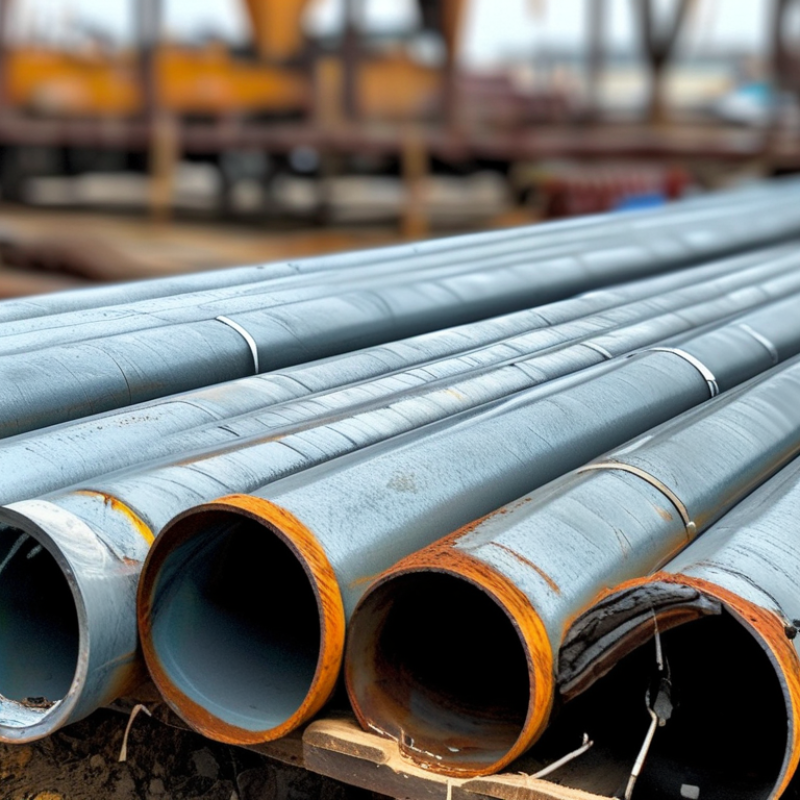
Global buyers should match galvanized pipe standards with the intended service. ASTM A53 Grade A or B suits many water, air, and structural applications. EN 10255 commonly uses S195T and S235T grades for threaded or plain-end steel tubes. API 5L grades serve pressure pipelines, but galvanized finishes require project-specific approval. These standards are not interchangeable.
Size selection affects flow, handling, and installation cost. Common export sizes range from DN15 to DN300, equivalent to NPS 1/2 through NPS 12. Wall thickness must be checked, not guessed. A DN50 pipe with a heavier schedule resists external damage better, yet increases weight and transport expense. Threaded ends need accurate dimensions, while grooved systems demand consistent outside diameters.
Coating quality matters more than a bright surface. ISO 1461 specifies hot-dip galvanized coating requirements, with minimum average zinc thickness typically ranging from 45 to 85 micrometres, depending on steel thickness. The International Zinc Association reports atmospheric zinc corrosion rates can remain below 1 micrometre per year in many rural environments, but industrial exposure may be several times higher. That figure is useful, though not universal. Salt spray, trapped moisture, and cut edges can shorten service life. Buyers should request coating-mass results, dimensional certificates, tensile data, and batch traceability. I would also verify the test method. Different laboratories can produce confusing comparisons.
Selecting galvanized pipes starts with the application, not the lowest quoted price. Hot-dip galvanized pipes usually suit outdoor frames, agricultural irrigation, and construction sites exposed to rain. Their zinc coating offers practical protection against moisture and surface corrosion. Pre-galvanized pipes may work well indoors, where humidity remains controlled. They can be easier to process, but cut edges need careful protection.
For drinking-water systems, verify the pipe’s approved use, coating condition, wall thickness, and internal cleanliness. Do not assume every galvanized pipe is suitable for potable service. Fire protection systems require compatible dimensions, pressure ratings, threaded ends, and local approval. In coastal regions, salt exposure can shorten service life, even with galvanizing. Consider thicker coatings, drainage design, or another material where corrosion risks remain high. Metric sizes are common in many markets, but regional standards still differ.
Tips: Request coating-thickness records, hydrostatic test results, dimensional reports, and material traceability. Check whether fittings, valves, and threads match the pipe standard. Inspect several bundles, not only one sample. A polished certificate is not enough. Small defects may appear after cutting or transport. Buyers should also compare total delivered cost, including packing, customs handling, spare lengths, and replacement risk. This step is often overlooked. A perfect selection method does not exist, so record the site conditions and review the choice after installation.
2026 Top Galvanized Pipe Types for Global Buyers
Selecting galvanized pipe starts with service conditions, not the lowest catalog price. Hot-dip galvanized welded pipe suits many water, structural, and general construction projects. Seamless galvanized pipe may serve higher-pressure applications when the base specification permits it. Electro-galvanized pipe is cleaner and thinner-coated, but it may need extra corrosion protection outdoors. Ask for outside diameter, wall thickness, zinc coating mass, steel grade, threading details, and applicable standards. Keep the application clear.
Inspection should combine documents and physical checks. Review the mill certificate, coating test results, dimensional report, and packing list. Inspect random bundles, not only the best-looking sample. Measure diameter and wall thickness with calibrated tools. Check threads for damage, burrs, and proper fit. Look for bare spots, heavy zinc runs, blocked ends, and wet storage stains. A salt-spray result alone does not prove field durability. Sampling plans can also miss problems. Reconsider them for large or high-value orders.
Pricing changes with steel, zinc, coating thickness, order quantity, testing, and port costs. Compare quotations using the same Incoterm and specification. A low offer may exclude inland delivery, inspection, or export packing. Shipping requires dry, stable bundles, separators, and protection from seawater exposure. Confirm container weight, bundle length, timber treatment requirements, customs documents, and destination handling charges. Build time for production, inspection, and transshipment. Small details hurt. A common mistake is trusting a promised dispatch date before checking material availability and vessel schedules. Ask for photos, batch records, and corrective-action procedures before payment milestones.
Please share your email with us to see your results.